Improving Prison Outcomes: Performance-Based Funding for Staff Retention, Post-Release Employment, and Recidivism Reduction

Introduction
A century ago, America had high ambitions for its prisons. In President Calvin Coolidge’s second State of the Union address, he envisioned prisons that provide Americans “with special training in order to reestablish in them the power to pursue a law-abiding existence in the social and economic life of the Nation.”
Today, America’s prisons fall far short of this optimistic vision and face staggering crises. Correctional facilities are crippled by the highest rates of employee turnover in the public sector, and correctional officers suffer from widespread depression and premature mortality.1,2 Many people released from prison do not find stable employment or housing and go on to commit additional crimes. Ultimately, very few people who leave prison do not return within 10 years.
The effects of poor prison outcomes on society are unacceptable: more taxes spent on prisons, more homelessness, and more crime.
These compounding crises have made one thing clear to policymakers, traditionally- and reform-minded alike: the status quo is unsustainable. State legislators can target each of these problems in corrections with policies that empower the officers and staff working in prisons to collaborate with each other, encourage innovative approaches to staff retention and prisoner rehabilitation, and reward measurable improvements over the status quo. Performance-based policies are effective and accountable ways to incentivize meaningful change in prisons. If designed correctly, such policies have the potential to inspire correctional staff to buy in to a truly rehabilitative mission and turn incarceration into a positive, socially transformative experience.
Governments have used incentive-based policies to improve probation and parole departments throughout the United States, as well as prisons around the world.Using these successful policies as models, policymakers should incentivize public and private prisons to perform better across a variety of clearly defined metrics related to officer retention and wellness, recidivism, and post-release employment. Policies rooted in empowerment, innovation, and accountability are the best pathway for America’s prisons to become the centers of opportunity and social intervention envisioned by President Coolidge and other principled reformers.
Problems in Corrections
Prisons across the country are in crisis. Few correctional facilities have adequate staffing levels to ensure a safe and secure environment for incarcerated people and officers alike. Poor employment outcomes and high recidivism remain persistent problems that are made worse by a general rise in crime in many cities and economic uncertainty.
Correctional Officer Retention and Wellness
Correctional officers and staff are the backbone of the prison system—without them, prisons cannot function. And yet, many prison officials are being forced to continue operations with dangerous levels of understaffing. The results have been disastrous: soaring rates of violence, overworked officers, and a lack of basic services like exercise, family visits, and hygiene.3
The corrections staffing crisis has been longstanding and is connected, at least partially, to broader declines in law enforcement employment. Over the last two decades, the number of law enforcement officers per capita nationally dropped by more than 10 percent.4 In the last decade alone, applications for law enforcement positions have dropped by more than half.5
But the crisis in corrections is even more acute. State prison systems have staggering officer vacancy rates, as high as one in three positions in Oklahoma, Nevada, and Texas and one in two positions in Mississippi and Alabama.6 Twelve states have vacancy rates over 20 percent, mostly in the south and southwest where correctional officer pay is lowest and prisons are the most geographically remote. But even well-paying, densely populated states like Massachusetts, Connecticut, and Delaware have vacancy rates between 10 and 15 percent.7 In some cases, statewide statistics mask the especially dire position of individual prisons.
The Georgia Department of Corrections has a 21 percent vacancy rate statewide, but it has reportedly reached vacancy rates of over 70 percent in certain prison units.8 Retention rates for existing staff are equally abysmal. A state auditor’s report for 2022 in Texas found that 70 percent of juvenile correctional officer positions and 39 percent of adult correctional officer positions had turned over in the previous twelve months.9 Estimates of how much states lose per officer who turns over range from $20,000 to more than $30,000.10
The major drivers of the understaffing crisis in corrections are not fully known, but they likely include a competitive job market for employers, low officer pay, poor staff culture, and constant risks to mental and physical health. Across the U.S. economy, job vacancies are near record highs as private and public sector employers alike struggle to attract and retain workers.11 Skyrocketing inflation has pressured even the most loyal employees to search for higher paying jobs.
In corrections, the job market has exacerbated the effects of existing weaknesses, namely chronically low officer pay. The Bureau of Justice Statistics estimates the median hourly wage for a correctional officer at $21.75, or roughly $45,180 annually.12 Starting pay for new officers is under $30,000 in some states.13 In comparison, the median wage for Americans at the beginning of their careers, between 25 and 34 years old, is over $25 per hour.14 Given the professional demands placed on correctional officers, it is not surprising that so few people are willing to endure so much for so little pay.
Policymakers in states like Texas have made modest pay raises to try to address the staffing crisis in corrections, but with limited success. The bigger problem, some correctional leaders argue, is culture.15 Existing employees suffer when officers leave and their workload increases, but there is no direct, positive incentive for employees to create a welcoming, supportive culture that helps retain new and existing officers. Instead, existing paramilitarized cultures and labor rules based on seniority place disproportionate burdens on new officers as part of a “paying dues” employment culture. The result is that many new officers simply leave.
One important but less visible challenge in corrections staffing is the mental and physical wellbeing of officers. Correctional officers live far shorter lives than average Americans, and even other law enforcement officers. Studies find that correctional officers live to an average age of between 59 and 62 years old, roughly 15 percent shorter than the average life expectancy for American men.16 Correctional officers have twice the suicide rate of police officers, 20 percent higher rates of divorce than the general population, and roughly three times the post-traumatic stress disorder rates of combat veterans of the wars in Iraq and Afghanistan.17 The deteriorating health of correctional professionals is a humanitarian tragedy, but it is also an occupational phenomenon relevant to policy discussions about the corrections employment crisis. Comprehensive policy solutions should consider not only the financial and cultural aspects of employment in corrections, but also the health and wellbeing of officers.
Post-Release Employment
Employment is crucial to the success of people released from prison. Yet, more than one in four formerly incarcerated people is unemployed, which is higher than the unemployment rate in the throes of the Great Depression.18 Prisons are failing to prepare people for the workforce after release, and as a result, most people cycle back into the criminal justice system.
Studies consistently find that employment is the factor most correlated with a person’s desistance from crime.19 One study of the United States Probation and Pretrial Services system found that people who were unemployed returned to prison at five times the rate of those who were employed.20 Moreover, eight in 10 of the people who failed to complete probation and returned to prison did not have jobs. The Missouri Department of Corrections found that 69 percent of people who failed to get jobs after release returned to prison within two years, whereas only 23 percent of employed people returned in the same period.21 Studies into the impact of certain characteristics of employment on recidivism found that job stability in particular decreased the likelihood of reoffending.22

Education and vocational training programs in prisons, if executed properly, can be effective solutions. A 2016 report by the RAND corporation found that people who participated in educational programs while in prison were 46 percent less likely to reoffend.23 A study on GED and college programs in Ohio’s prisons found that the closer that inmates completed their programs to their release date, the less likely they were to return to prison.24 But it is important to note that educational programs and vocational training are associated with reduced recidivism primarily because of their effects on job acquisition, job stability, and income. Evidence from other studies regarding the elasticity of crime with respect to wage rates suggests that a significant part of the measured effect of education on crime can be attributed to the increase in wages associated with schooling. Higher wage employment, not schooling itself, raises the opportunity cost of crime and thus reduces criminal activity.25 Thus, for prison vocational and educational programs to be successful interventions, they should target in-demand labor opportunities and be held accountable for achieving measurable employment outcomes.

Recidivism
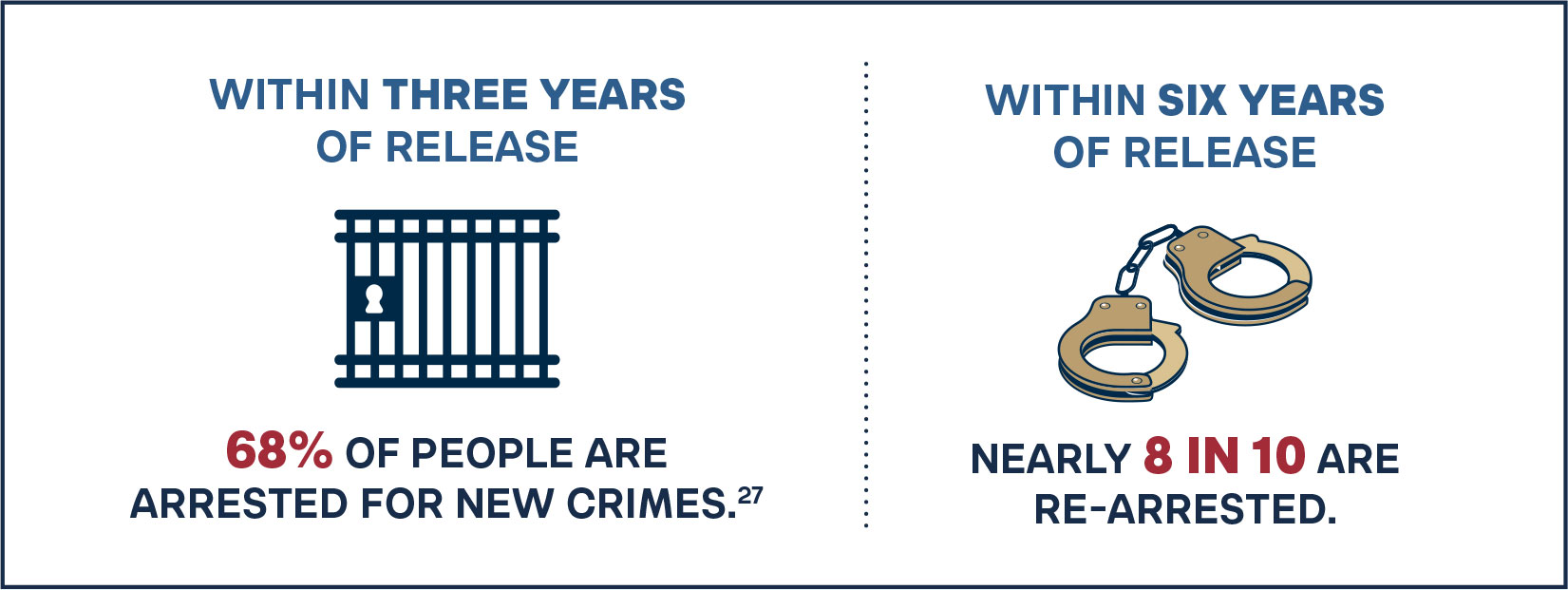
Ultimately, public safety is the central concern of the criminal justice system, and thus of prisons. Whether prisons are used for incapacitation, deterrence, or rehabilitation, their primary purpose is to respond to crime. With 95 percent of state prisoners eventually released back into their communities, the stakes for public safety are high.26 Corrections systems, however, continue to fail in this regard. Within three years of release, 68 percent of people are arrested for new crimes.27 Within six years, nearly eight in 10 are re-arrested. Many people go on to commit worse crimes than those for which they were imprisoned. For example, a Bureau of Justice Statistics report released in 2021 showed that people released from prison for drug crimes were more likely to be re-arrested for a violent offense than people who had committed homicide or sexual assault.28 The same study found that just over 30 percent of people imprisoned for property crimes like burglary and larceny went on to commit violent crimes within five years. If the goal of corrections is to correct behavior and make the public safer, then our prisons need to make substantial improvements and be held accountable for achieving measurable reductions in recidivism.
Promising Policies in Adjacent Contexts
One of the most promising policy approaches to improving the effectiveness of the criminal justice system is to tie an institution’s funding to measurable outcomes. So-called “performance incentive funding” has been used in the United States and around the world to incentivize better results in probation, parole, and prisons.
U.S. State-level Probation and Parole
States as diverse as Arizona, California, Illinois, Texas, and Utah have deployed performance incentive funding programs to address shortcomings in their respective probation and parole systems. Performance incentives have enormous potential to motivate officers, improve departmental culture, and reward hard work. Currently, most administrators of probation and parole departments do not have much authority to encourage their officers to do better or reward them when they do. One study into how probation officers viewed their roles found that 36 percent of officers were apathetic about their potential to impact the lives of their clients, citing
a lack of incentives to work harder.29 Performance incentive funding targets this problem directly.
Performance incentive funding accounts for the reality that what works in one place does not necessarily work in another. Rather than mandating a department to adopt a certain program that worked in one location to a new location, performance incentive funding rewards any local program that achieves measurable results. This outcomes-based approach aligns the incentives of practitioners—supervision officers, specialists, and program coordinators—with desirable results for those they serve and rewards positive innovations.
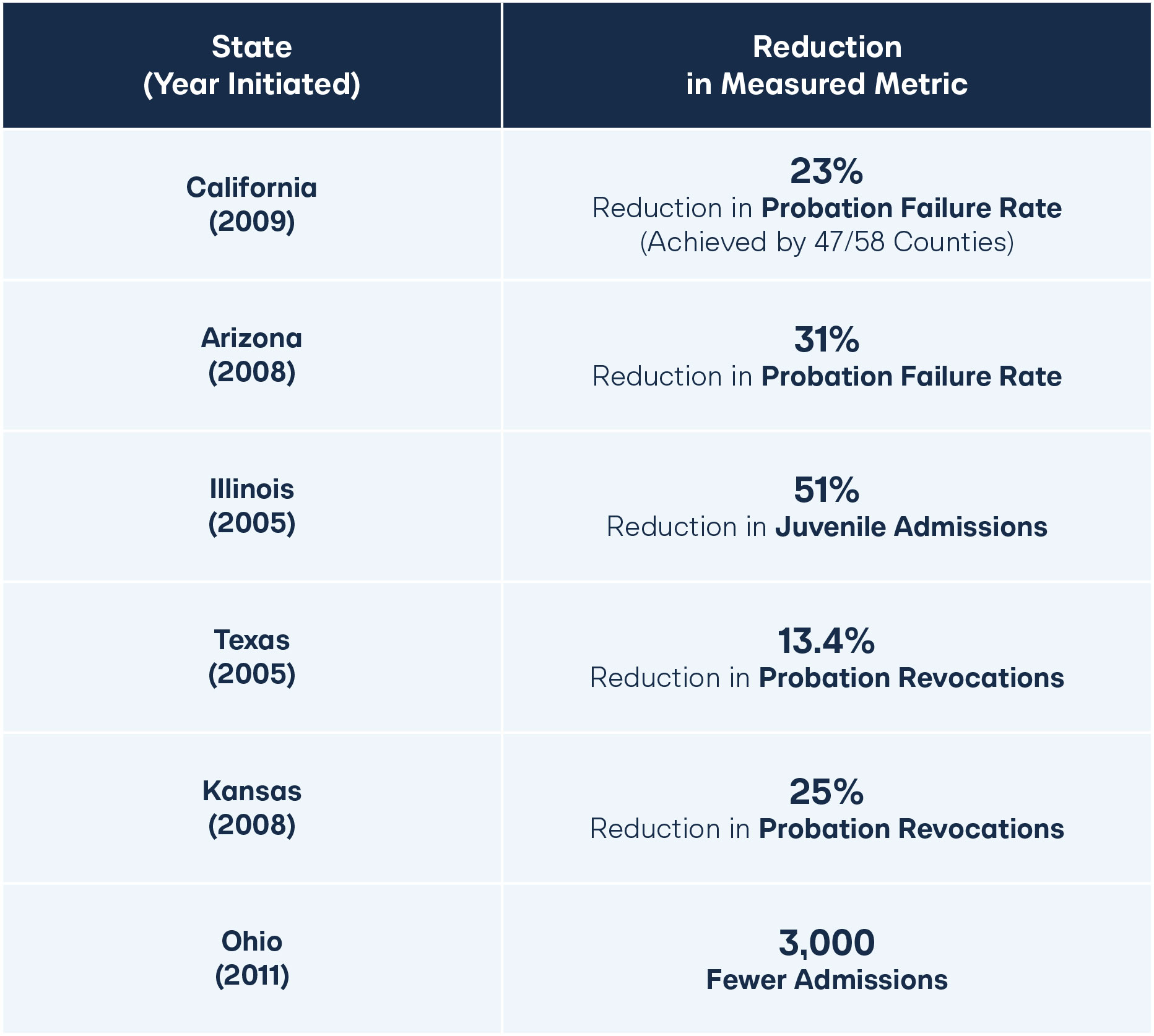
Several states have adopted performance incentive funding programs over the last decade and a half, demonstrating considerable success. California created the nation’s largest performance incentive funding program for probation in 2009. The program incentivizes probation departments to effectively rehabilitate people on supervision, assist them in finding jobs, and otherwise support them during re-entry back into their communities. Within the first three years, the program helped probation officers keep 27,000 people out of prison and saved Californians $230 million in averted corrections costs.30 Forty-seven out of 58 county probation departments reduced probation failures an average of 23 percent.31 Arizona adopted a similar program, and its county probation departments reduced probation failures by 31 percent at the same time that the state’s crime rate fell by more than a quarter.32 Illinois’s performance incentive funding program in juvenile corrections reduced the number of juveniles admitted to youth corrections facilities by 51 percent.33 The adult version of the program was also successful, with one forthcoming study showing that 88 percent of probationers who were supervised by departments receiving incentive funding described their experience as a genuine second chance made possible by supportive officers with a concerted focus on rehabilitation.34
Other states have adopted smaller performance-based funding programs. Texas used performance-based funding to incentivize probation departments to adopt graduated sanctions in 2005. Participating departments reduced revocations by 13.4 percent, compared to a 5.9 percent increase in revocations among departments that opted out of the incentive program.35 Performance-based grants for probation helped Kansas reduce revocations by 25 percent over three years.36 A similar grant program in Ohio kept roughly 3,000 people out of prison between 2012– 2016.37 A meta-study of performance incentive funding programs found that each of the seventeen programs studied successfully reduced recidivism.38
State Probation and Parole Performance-based Funding Reform: Efforts and Results
U.S. Private Prisons and Community Corrections
There are two major instances in which state or federal governments in the U.S. applied performance-based funding to corrections. The first occurred in the late 1990s when the U.S. Bureau of Prisons (BOP) incorporated performance incentives into its contract with Wackenhut Corrections Corporation to operate the Taft Correctional Institution in California (TCI). TCI was evaluated based on its level of misconduct among inmates, receiving penalties for low performance and financial awards of up to 5 percent of the total contract value for high performance. Over its five years of evaluation, TCI steadily improved its performance, reduced its penalties, and received award funding. Overall, TCI did not perform as well as comparable prisons run by the Bureau of Prisons based on the misconduct metrics used in its evaluation.39
The second instance of performance-based funding in corrections occurred in 2013, after Pennsylvania Governor Tom Corbett canceled the state’s contracts with private community corrections providers. Governor Corbett’s administration rebid new contracts to pay out based on each provider’s ability to measurably reduce recidivism.40 The new contracts were a success. Statewide, community corrections recidivism decreased by 11.3 percent by the second year, and six of the 42 community corrections centers improved enough to qualify for incentive payments.41
International Prisons
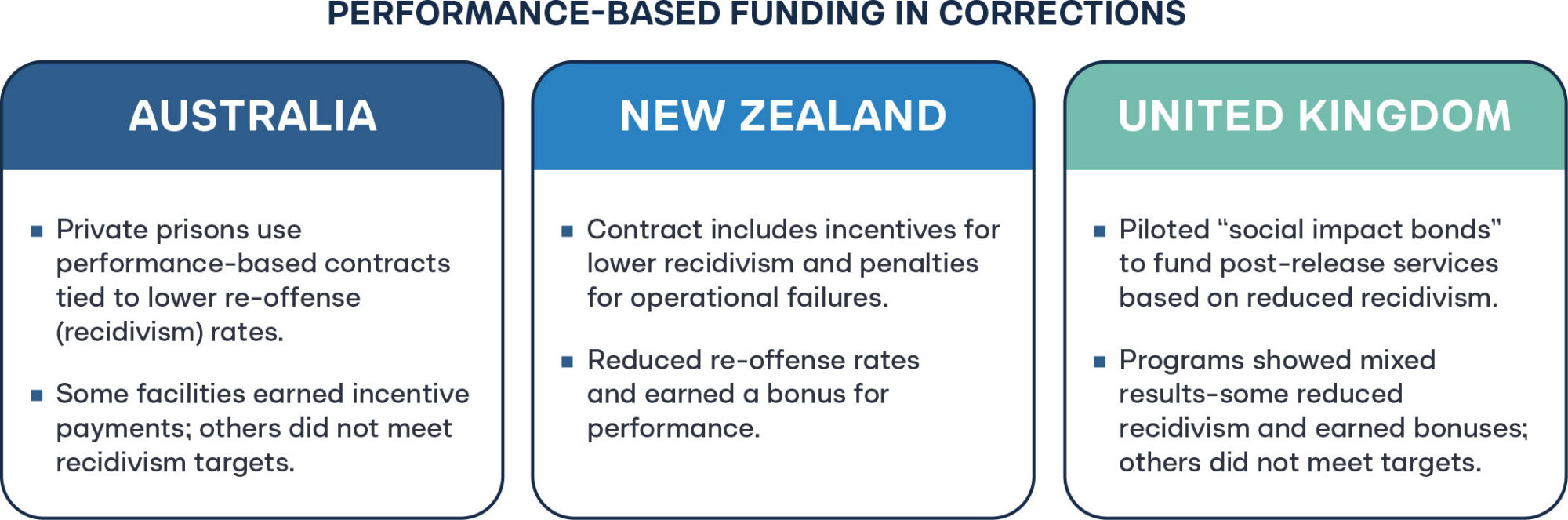
Internationally, performance-based funding is used more commonly for corrections than in the United States. Governments in Australia and New Zealand have used performance-based contracts with private correctional facilities, and the United Kingdom has experimented with social impact bonds—a variant of performance-based funding—in post-release services.
Three private prisons in Australia have experimented with performance-based funding. The GEO Group facility in Ravenhall, Australia receives 2.5 percent of its service fee based on whether or not the re-offense rates of people released from that facility out-perform the public prisons in the same jurisdiction.42 The Ravenhall facility has consistently succeeded on this metric, receiving $2 million for achieving a lower recidivism rate in 2019.43
The Western Australia Department of Corrective Service’s 5-year contract with private prison conglomerate Sodexo, beginning in December 2016, paid $15,000 (Australian Dollars) for each person who stayed out of prison for at least two years following their release from Sodexo’s correctional facility for women, if the total recidivism rate is lower than a specific benchmark.44 Only prisoners who had spent at least 75 percent of their sentence in Sodexo’s facility were included in the recidivism measurements. The contract had tiers of success, with re-offense rates below 27 percent receiving full payment, rates between 27 and 30.5 percent receiving 75 percent of the incentive payment, rates between 30.6 percent and 34 percent receiving 50 percent of the incentive payment, and rates greater than 34 percent receiving no payment at all.45 The facility, however, did not meet these goals. Its recidivism rates were 50 percent in the 2018/19 fiscal year, and 67 percent in the first half of the 2019/2020 fiscal year.46
The contract also included other performance-based funding metrics, such as the rate of inmates achieving parole. In 2018, the facility exceeded the 30 percent parole achievement rate with 39.4 percent in the first half of the year and 41.7 percent in the second half, receiving $280 for every individual above the baseline.47 In December 2019, Sodexo entered into an agreement with the Western Australian government to end its contract early due, in part because of operational failures and infrastructure issues.48
Starting in 2019, the Parklea facility in New South Wales, Australia, operated by MTC Ventia became eligible for a variety of performance-based payments.49 Each month, the facility is evaluated based on 25 key performance indicators (KPI), each worth a certain number of points, and paid out according to those metrics. Annually, the facility’s reincarceration rate is measured against a baseline reincarceration rate, and if the facility has improved, then it receives an incentive payment. Evaluations of the Parklea facility’s performance have not been released yet.
In New Zealand, Serco manages the Auckland South Correctional Facility under a performance-based contract that includes incentive payments for reduced recidivism and penalties for operational failures.50 Performance is based on six KPIs related to serious operational failures, such as escapes or riots, 36 KPIs related to lesser security issues, and 16 KPIs related to long-term social outcomes.51 Notably, the penalties for low performance on operational KPIs are not static. Instead, a long period of good performance on operational KPIs can negate an isolated failure, whereas repeated poor performance results in increasing penalties. The incentive portion of the contract is tied to reduced 24-month recidivism rates compared to publicly operated facilities. The incentive payments target outcomes for indigenous people in addition to outcomes for the general population in order to discourage prison administrators from “cherry-picking” the least risky inmates for the best services. The facility must improve outcomes for the higher-risk indigenous population in order to be eligible for incentives for improving outcomes for the general population.52 As of 2019, Serco had minimal penalties of less than 0.5 percent of its operating budget and had successfully earned incentive payments for reducing recidivism. The Auckland facility reduced re-offense rates by 12.52 percent for the indigenous population and 36.56 percent for the general population compared to publicly operated prisons in New Zealand. Serco received a bonus of $1.1 million for its performance in 2018.53
The United Kingdom piloted a performance-based funding model called a “social impact bond” in 2010. A private organization, Social Finance, agreed to raise up-front funds for charities and foundations to pay for post-release services for people released from HMP Peterborough, on the condition that the Ministry of Justice would pay a return to those investors if the services proved to reduce recidivism compared to a control group. The program was shown to reduce recidivism by 8.4 percent compared to the control group, and the investors received a bonus payment.54 Another pilot program at HMP Doncaster penalized a service provider if it did not reduce recidivism by five percent or more compared to a baseline.This program had mixed results, with one cohort reoffending at a rate of 5.7 percent less than the baseline, and a second cohort reoffending only 3.3 percent less than the baseline.55
International Incentive-Based Funding in Prisons: Metrics and Results
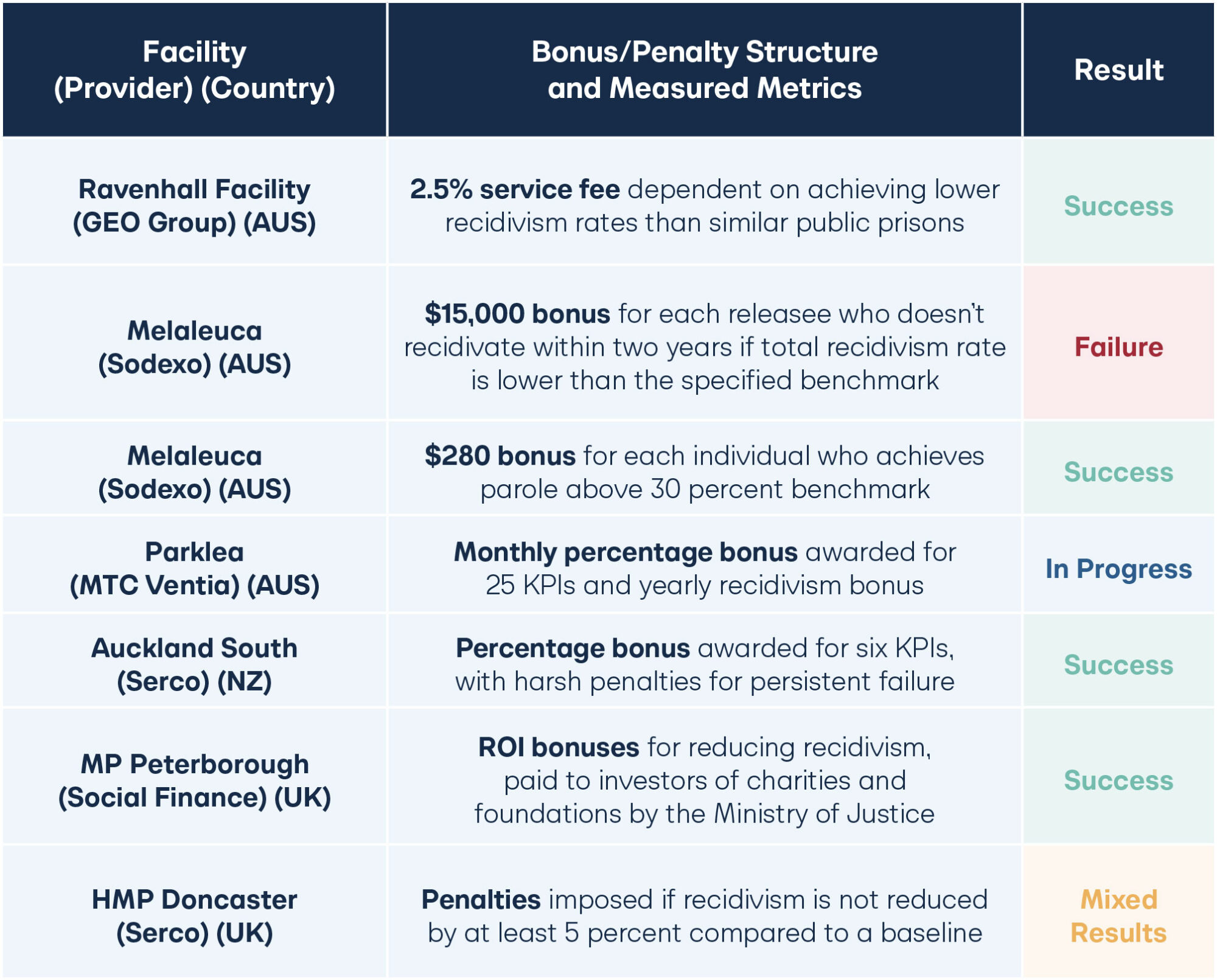
In an international context, performance-based contracting has demonstrated mixed but generally positive results. Most of the metrics used to evaluate performance and determine eligibility for incentive payments were tied to recidivism. Other metrics focused on security or service provision, such as educational programs. Metrics like longitudinal post-release employment outcomes or officer retention and satisfaction are not found in these contracts.
Overall, the evidence from U.S. probation and parole, U.S. private corrections, and international private corrections suggests that performance-based funding can lead to better outcomes. The strongest performance-based funding models all tied financial incentives to clear and straight forward measures of final outcomes, namely recidivism. Models that used too many intermediary performance measures that were not tied to final outcomes, such as the Sodexo facility in Western Australia or the Taft Correctional Institution in California, were notably less successful than the models with narrow metrics and financial incentives tied to final outcomes.
Policy Proposals
Top-down, one-size-fits-all policies will not fix America’s prisons. Instead, policymakers should empower the people working in prisons to create innovative approaches to rehabilitation and other key performance indicators, give them ownership of their success, and directly reward measurably better outcomes. Performance incentive funding is the best way to accomplish these goals. Performance-based funding holds prisons accountable for making improvements, helps transform institutional culture by aligning incentives, and provides additional funding for strategies and programs that are proven to be effective. Performance metrics should be simple enough for everyone employed within an institution to easily understand, and they should be tied to ultimate outcomes, such as officer retention, recidivism reduction, and post-release employment. Though intermediary metrics like the number of officers hired, inmates in substance abuse treatment, and/or vocational programs completed may be associated with each of the aforementioned ultimate outcomes, these metrics do not actually measure success. Intermediary metrics are often proximate to or associated with success but relying on these metrics can stifle innovation and waste resources on ineffective programs or policies. These metrics should be tracked to find causal associations between specific programs or strategies and better outcomes, but performance funding should be tied strictly to outcomes.
Policymakers should apply performance-based funding to both private and public prisons. Redesigning private prison contracts to include financial bonuses for improved performance aligns the profit incentives of private prison companies with socially beneficial outcomes. Funding streams for public prisons can similarly be aligned with outcomes, though the dispersion of financial benefits from improved performance would need to comply with state budgetary processes and civil service rules.
Officer Retention Performance Incentive Funding
To target officer retention rates using performance incentive funding, policymakers should financially reward prisons and their staff when their 12- and 24-month retention rates increase. The financial reward should be split between the facility’s budget for staff wellness or recreation and equal pay bonuses for every staff member and officer within the facility. At least three-quarters of the reward funds should go towards bonuses because bonuses are the most direct incentive for employees to improve outcomes.
This approach targets institutional culture in a way that simple retention bonuses for new employees do not. By allowing everyone to share in the success of increased employee retention, this policy empowers veteran employees to prioritize the satisfaction of new employees.
Targeting 12- and 24-month retention rates is the most sensible time range because retention rates for correctional officers within the first few years of employment are particularly problematic, as mentioned previously in this paper’s section on Correctional Officer Retention and Wellness. The other advantage of this time range is that facilities and staff can earn incentive rewards as early as one year from the start of the program. Longer range metrics, such as five-year retention, may be worthwhile, but their strategic value is hindered by longer lag times before a facility is eligible for reward funding.
Post-Release Employment Performance Incentive Funding
Policymakers should tie performance-based funding to post-release employment outcomes. In states with parole or other types of post-release supervision, this metric is very easy to capture since people leaving prison will continue to be monitored for a significant amount of time after release. Each prison should track the one-year full-time employment rate for people released from their facility and receive incentive funding if that rate is higher than that facility’s historical baseline employment rate. Reward funds should go towards the facility’s budget for educational and vocational training, work release programs, and job coaching.
Recidivism Performance Incentive Funding
Targeting recidivism reduction with performance incentive funding is challenging because of the amount of data it requires. Some state departments of corrections, however, have made strides in improving the quality and quantity of data collection. Organizations like Recidiviz have pioneered data platforms that allow departments of corrections to see granular performance data in real time. These developments are promising for the prospects of policies that tie performance-based funding to recidivism.
There are a number of ways to measure recidivism reduction, and state policymakers will need to determine which metrics best align with the data available in their departments of corrections. The simplest approach is to reward the entire state department of corrections with additional funding for programming and equal staff bonuses if it improves its two- and five-year recidivism metrics compared to statewide baselines. The advantages of system-wide incentives include deterring “cherry-picking” of the best prisoners by certain facilities and requiring less granular data than facility-specific incentives. The disadvantage of this approach is that the incentive structure penalizes the best facilities and rewards the worst facilities compared to an incentive structure that rewards facilities based on their specific performance.
Another approach is to reward specific facilities based on their individual two- and five-year recidivism metrics compared to that facility’s historical baseline recidivism rates for people who spent at least 60 percent of their sentence in that facility. This approach offers a reward that is most proximate to the individuals working in a particular prison, but it encourages facilities to “cherry pick” prisoners who pose the least risk. This problem is ameliorated to some extent by existing security classifications for facilities and using facility-specific baselines as opposed to open competition among all prisons in a state to achieve the best recidivism rates. Requiring the individuals included in the recidivism measurements to have spent at least 60 percent of their sentences in a particular prison addresses the problem of prisoner transfer among facilities, but it may undercount prisoners who frequently transfer.
A more creative but data-intensive approach would be to tie the incentives to the average time between prison stays among people released from either a state corrections system as a whole or a particular facility, compared to historical baselines. A higher average time between prison stays indicates that either more people are staying out of prison or those who do return are returning less frequently, or both. The advantage of this metric is that it accounts for the reality that most people who leave prison do in fact return and rewards a broader spectrum of positive outcomes than only total desistance from crime.The primary disadvantage is the amount and granularity of the data required to track this metric.
While a pilot program could use any one of these metrics, the likely best option is to utilize a combination of these measures in order to get a more comprehensive evaluation of performance and mitigate the disadvantages of any one metric.
Conclusion
Performance-based funding aligns the incentives of the criminal justice system with the key outcomes that the public expects. Given the fact that more than 95 percent of people who go to prison will be released eventually, prisons can play a crucial role in crime prevention and reducing the number of repeat offenders.The strength of performance-based reforms to prisons is that they re-orient prison operations towards programming, rehabilitative interventions, and vocational training while ensuring that those changes actually deliver on their intentions: more jobs, less substance abuse, and less crime.
The evidence in favor of performance-based policies is strong, and policymakers are paying increased attention to performance incentive frameworks. Over the last two years, the Arizona and Utah state legislatures have each adopted performance-based funding in an effort to improve community supervision outcomes. State policymakers should continue to build momentum behind performance-based funding policies and apply incentive frameworks to other issues in corrections, namely officer retention, post-release employment, and recidivism. Perhaps the most compelling aspect of performance-based funding policies is that they only pay out if the desired outcomes are actually achieved. Thus, the risk of these policies is minimal, and the potential social benefit is immense.
America has not yet realized the ambitious vision for corrections laid out by President Coolidge a century ago. But with the right policy frameworks, America’s prisons can make strides towards becoming centers of opportunity, rehabilitation, and restoration.

Stay Informed
Sign up to receive updates about our fight for policies at the state level that restore liberty through transparency and accountability in American governance.