
2026 Playbook for Certificate of Need Repeal
Ranking Certificate of Need Laws in All 50 States and Puerto Rico


Executive Summary
Across America, Certificate of Need laws remain a pervasive barrier, inhibiting access, quality, and affordability across the healthcare system. After more than five decades, reform often proves difficult. Yet recent legislative activity hints that the outdated regime is finally crumbling. The 2026 legislative sessions marked a significant year for repeal, driven in part by the incentives from the Rural Health Transformation Program.
The Rural Health Transformation Program (RHTP), a five-year, $50 billion initiative administered by the Centers for Medicare & Medicaid Services (CMS), uses its funding to shape state incentives for reform. CMS included the repeal of the Certificate of Need among the policy factors weighed in the program’s competitive technical score component. CMS uses the Cicero Institute’s scoring methodology—the same nine-category framework used in this report—to evaluate the restrictiveness of each state’s CON regime.
This third annual update to the Cicero Institute’s Certificate of Need (CON) report reflects legislative activity through the 2026 sessions. It builds on the methodology and 50-state ranking first published in “A Policymaking Playbook for Certificate of Need Repeal: Ranking Certificate of Need Laws in All 50 States,”1 and carried forward in the “2025 Playbook for Certificate of Need Repeal,”2 applying the same framework to capture legislative changes enacted since that publication.
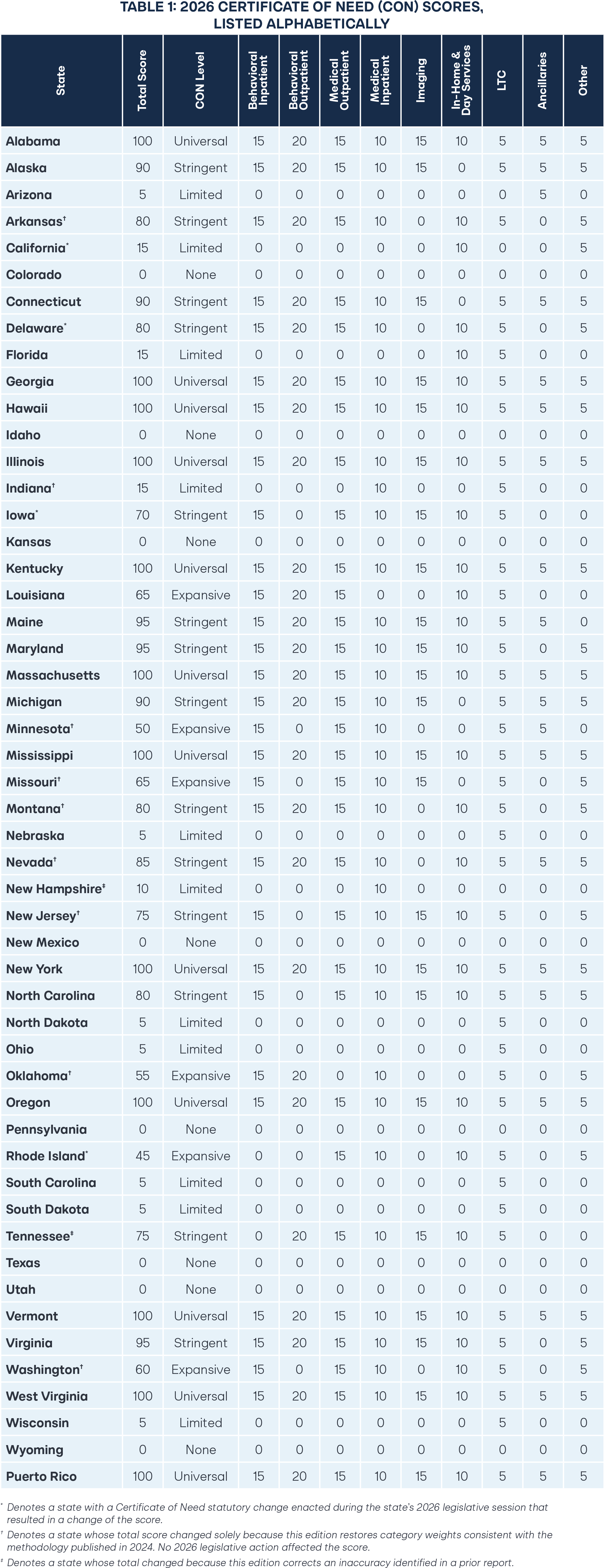
Appendix: For a more detailed breakdown of the scores in each category for each state, see the accompanying scoring spreadsheet: https://docs.google.com/spreadsheets/d/1PUX2-3Sy5IsdUsvf_yE9Da6J5GelE1sBLBtsK5QIQ14/edit?gid=1962736597#gid=1962736597
Summary of 2026 Enacted Legislation and Riders
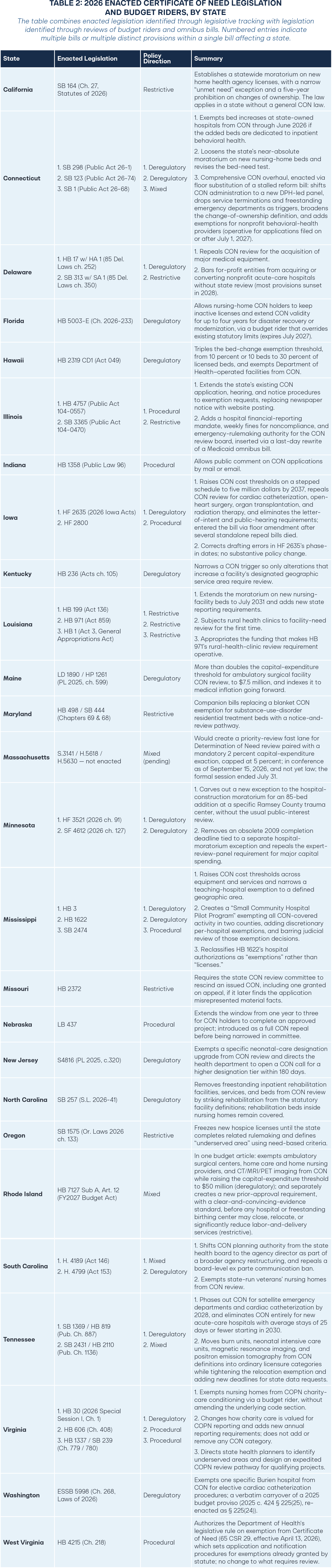
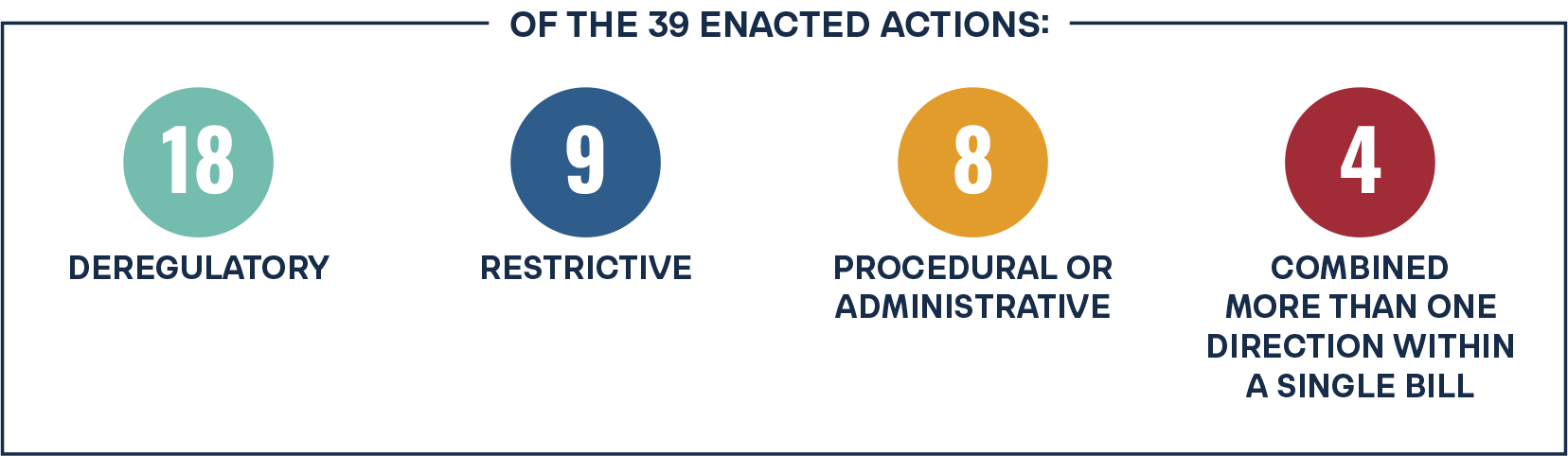
Table 2 captures CON-related legislative activity across 25 states, including enacted changes made through standalone legislation, omnibus bills, budget measures, and other legislative vehicles. It also identifies one Massachusetts measure still pending in conference as of September 15, 2026. The table classifies each provision by its primary policy direction: deregulatory, restrictive, procedural, or mixed. Of the 39 enacted actions, 18 moved in a deregulatory direction, nine were restrictive, eight were procedural or administrative, and four combined more than one direction within a single bill.
A recurring feature of the 2026 legislative action was the CON rider. Rather than standalone repeal bills, many substantive changes were carried on budget, omnibus, or agency-restructuring vehicles rather than dedicated CON bills. Several were inserted through late floor amendments after standalone repeal bills stalled or died in committee. This pattern has a practical implication for tracking nationwide reform efforts. A caption-only search for “certificate of need” would miss a meaningful share of the year’s actual statutory change. A comprehensive review, therefore, requires examining budget measures, omnibus bills, amendments, and related health policy legislation in addition to legislation specifically focused on CON.
State Legislative Highlights
Rhode Island
Rhode Island enacted the most sweeping Certificate of Need repeal of any state during the 2026 legislative session. The state dramatically narrowed the statutory definition of “healthcare facility,” removing behavioral health services in hospitals, community mental health centers, alcohol and drug abuse centers, public health centers, and burn units from CON review entirely. Ambulatory surgical centers, home care providers, and home nursing providers were also removed, though hospice remains covered. Magnetic resonance imaging, computed tomography, and positron emission tomography equipment were exempted from review, as were independent diagnostic centers and mobile diagnostic testing facilities. Rhode Island also raised the dollar threshold that triggers review of capital spending by existing facilities from $5.25 million in statute to $50 million, indexed to the Consumer Price Index each July going forward. Building a new healthcare facility still requires a Certificate of Need at any cost; that trigger was left untouched.
Combined, these changes lower Rhode Island’s estimated score from 100 to 45, the largest single-year reduction Cicero Institute has recorded. Though Certificate of Need requirements remain in place for select medical outpatient services, in-home and day services, and long-term care facilities, Rhode Island also narrowed who may challenge a CON decision after it is issued, limiting standing to the applicant itself rather than any competitor or interested party—a procedural change that does not affect the category score but removes a tool incumbents have used to delay approved projects through litigation after the fact. Rhode Island’s reform is an impressive achievement.
Iowa
Iowa’s ambitious CON repeals included removing community mental health centers from CON review under the behavioral outpatient category. It also eliminated cardiac catheterization, open-heart surgery, radiotherapy, and organ transplant services from CON review, which will dramatically increase Iowans’ access to timely care. Iowa also repealed CON review for replacement equipment entirely, raised the general capital-expenditure and equipment-acquisition threshold to $4 million, effective 2027 (stepping to $4.5 million in 2032 and $5 million in 2037), and struck CON review for both the closure and the expansion of services under the “other” category. Iowa also repealed CON review for air ambulance transport. Taken together, these changes lowered Iowa’s estimated score from 90 to 70.
In 2026, Iowa substantially revised the procedural machinery that incumbents used to block competitors. Notably, Iowa’s CON regime used to require applicants to file a redundant and burdensome ‘letter of intent’ before a CON application could be filed, giving incumbents advance notice to organize opposition before a hearing was ever scheduled. Iowa also narrowed who may formally object to a new application: regulators no longer have to find that existing facilities are already being used efficiently before approving a competitor, standing no longer extends to a facility that merely filed notice it might offer a similar service someday, and third-party payers lost the right to object at all. None of these procedural changes moves the category score, but together they close off the tools incumbents and insurers have used for years to stall or defeat competitors’ applications without ever winning on the merits.
California
California moved in the opposite direction from the other states in this report. The state repealed its Certificate of Need law in 1987 and has scored 0 in every prior edition. In June 2026, the health budget trailer bill, SB 164, established a new entry restriction (moratorium) without ever using the term certificate of need. The bill bars the Department of Public Health from licensing any new home health agency or branch office until the department finishes rewriting its regulations, with no deadline for doing so. Applicants may receive a license during the moratorium only if the department makes a written finding that the applicant has demonstrated an “unmet need” for home health services in its area, judged on the number of agencies already operating there. Licenses cannot be sold or transferred for five years, and the unmet-need requirement was also incorporated into the ordinary licensing rules, meaning that it remains in effect after the moratorium ends. Under this report’s methodology, these restrictions raise California’s score from 0 to 15—10 points for in-home services and five for the ownership-transfer bar. This was the only score that increased in 2026.
Puerto Rico
Though not well known, Puerto Rico also has an extensive Certificate of Need and Convenience (CNC) program, which was enacted in the 1970s alongside the states with the federal National Health Planning and Resources Development Act. Like other states, Puerto Rico kept the laws in place when the federal government repealed the act just over a decade later.
Scholars at the Instituto de Libertad Económica para Puerto Rico recently published a piece, “How Certificates of Need and Convenience Limit Health-Care Investment and Access in Puerto Rico.”3 The piece highlights different types of facilities and services that trigger a CNC. The CNC triggers listed in the article were aligned with this report’s methodology for calculating Puerto Rico’s 2026 score. Tracking all CNC triggers as comprehensively as possible is vital for effective reform. Future editions of this report will include Puerto Rico alongside all 50 states.
Conclusion
Taken as a whole, the 2026 legislative sessions produced a meaningful retreat from Certificate of Need regulation. Twenty-five states acted on their CON laws; three—Rhode Island, Iowa, and Delaware—repealed entire categories of review, and Rhode Island’s 55-point drop is the largest single-year change recorded by this report. Most of the remaining activity was incremental: higher dollar thresholds, narrower triggers, targeted exemptions, and procedural cleanup that does not change a category score but chips away at the tools incumbents use to block competitors.
The Rural Health Transformation Program appears to have sharpened the incentive for reform. The repeal strategy laid out in the 2025 Playbook—behavioral health, maternal health, diagnostics, and heart health first—continues to reflect where the repeals actually landed: Rhode Island and Iowa both cleared CON requirements for behavioral health; Rhode Island and Delaware repealed imaging; and Iowa and Tennessee acted on cardiac services. As Certificate of Need regimes decay nationwide, American patients will at last get the care they so deserve.

Stay Informed
Sign up to receive updates about our fight for policies at the state level that restore liberty through transparency and accountability in American governance.