
California’s Exposure Under the FY2026 Homelessness Assistance Continuum of Care NOFO
An estimate of federal homelessness-assistance award changes


Summary
California’s 44 Continuums of Care (CoCs) received $683.8 million in the fiscal year 2024 CoC program competition, the most recent competition HUD completed.1 In fiscal year 2025, after litigation stopped the competition, HUD renewed California’s expiring grants noncompetitively at $719.0 million across three quarterly rounds.2 HUD’s Annual Renewal Demand Report puts the annual cost of simply renewing California’s existing CoC portfolio at $671.5 million across the 44 CoCs.3 Therefore, HUD is providing more than $700 million in federal assistance that largely goes to renewing rental subsidies through the Continuum of Care Program in California.
The FY2026 CoC Notice of Funding Opportunity (NOFO), published June 1, 2026, restructures the funding priorities of the Continuum of Care Program.4 Perhaps most significantly for California, the NOFO reduces to 60 percent of each CoC’s annual renewal demand in Tier 1, down from the roughly 90 percent of renewals that HUD awarded in every competition from FY2012 through FY2024.5 It sets aside $1.3 billion of the $4.04 billion available for new projects, with new transitional housing (TH) and supportive-services-only (SSO) projects selected first.6 The NOFO now scores CoC applications on criteria that reward treatment and recovery services (20 of 200 points) and mandatory service participation (eight of 200 points), criteria that run directly counter to the Housing First model California has written into state law and braided throughout its own homelessness funding.7
Given California’s commitment to Housing First via SB 1380 (2016), which requires every state dollar dedicated to homelessness to follow a Housing First approach, the Continuum of Care projects in California are likely to receive less federal funding. This paper models the potential impact that federal CoC Program changes may have in California and the legal, policy, and program priorities California CoCs hold that potentially conflict with new federal priorities.
This analysis envisions two scenarios. In the first scenario, California’s CoCs do not pivot toward the new priorities, resulting in a net loss of about $225 million per year, roughly a third of the state’s renewal demand.8 The second scenario assumes California CoCs partially pivot, reallocating some renewal money into new transitional housing (TH) and supportive-services-only (SSO) applications and capturing part of the new-project bonus. That scenario results in a net loss of about $160 million per year.9
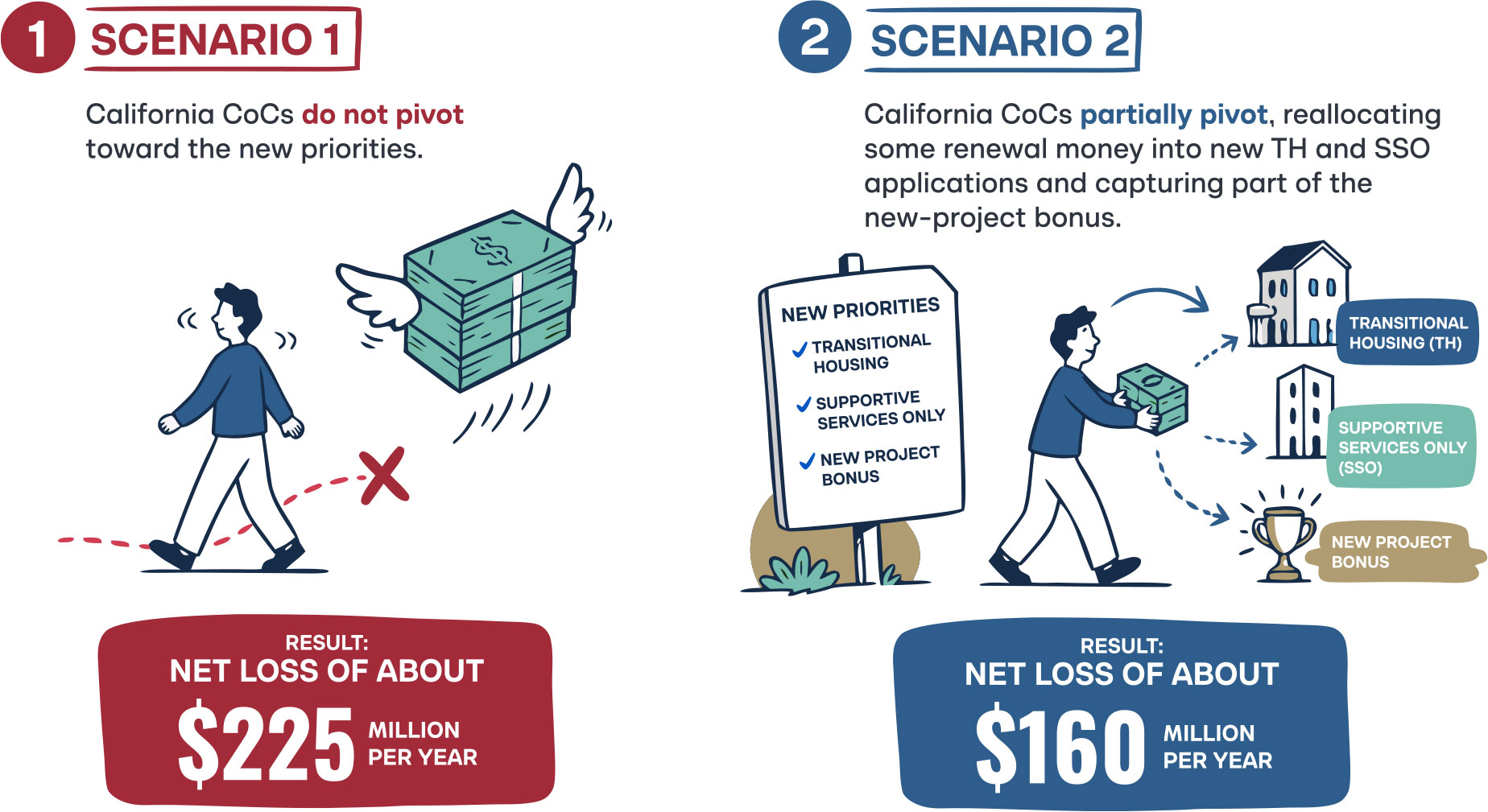
Two federal lawsuits sought to set HUD’s program reforms aside. The suits claimed that HUD violated the Administrative Procedure Act and that it did not base changes to the FY2026 NOFO on “evidence-based practices.” However, the First Circuit Court of Appeals stayed a lower court’s injunction of the competition, clearing the way for HUD to proceed with its funding reforms and priorities. HUD must announce FY2026 awards by December 1, 2026, which is when this projection will be graded.10
How California is Exposed
Portfolio Composition
California CoCs invest a majority of their federal awards in permanent supportive housing. Permanent supportive housing (PSH) accounted for $478.5 million of California’s $683.8 million FY2024 award, 70 percent of the total.11 Renewals of existing projects took 87.4 percent of the FY2024 award while transitional housing took one percent.12 The FY2023 shares were nearly identical: $415.7 million of PSH in a $594 million award, with renewals at 85.4 percent.13 The state’s physical inventory matches its grant portfolio: California reported 87,362 year-round PSH beds in the January 2025 Housing Inventory Count compared with 13,818 transitional housing beds. Permanent housing beds of all types outnumber transitional beds by roughly 11 to one.14
The new HUD CoC Program housing priorities focus on creating more transitional housing and providing funding for support services, such as outreach. The NOFO’s 60 percent cap on Tier 1 renewals is an attempt to force CoCs to invest in housing types other than PSH.
State Law Requirements
SB 1380, enacted in 2016, committed California by statute to Housing First across its homelessness programs.15 The operative chapter, reenacted effective June 29, 2026, defines Housing First as “the evidence-based model that uses housing as a tool, rather than a reward, for recovery,” with services offered “as needed and requested on a voluntary basis.”16 Its core components include tenant screening “regardless of their sobriety or use of substances, completion of treatment, or participation in services” and the rule that “[p]articipation in services or program compliance is not a condition of permanent housing tenancy.”17
SB 1380 binds California state agencies and departments administering “state programs” to the Housing First approach. Its application to local grantees is less clear.18 The definition of state programs carves out “federally funded programs with requirements inconsistent with this chapter.”19 CoC grants flow from HUD to counties, cities, and nonprofits without passing through state agencies, so nothing in the statute technically forbids a California CoC from chasing the FY2026 NOFO’s scoring points on a purely federal project; because the NOFO’s treatment criteria are scoring preferences rather than federal requirements, the carve-out for genuine federal conflicts is not triggered. California’s exposure is therefore not a statutory prohibition per se; it is a portfolio lock-in that comes from three sources.
Braided Money, One System, No Alternative Infrastructure
First, California’s law could impact local grants by shaping how local efforts braid state and federal awards to address homelessness. Cities and counties in California rely on state funding, mostly through the Homeless Housing, Assistance and Prevention (HHAP) program. HHAP adopts the California Welfare and Institutions Code § 8255 definition wholesale, “including all of the core components listed therein.”20 Every HHAP round statutorily requires that recipients “shall comply with Housing First.” Round five carries the same condition into the regional program that now governs the money.21 Eligible applicants for HHAP’s $760 million round of funding are California’s 44 HUD-identified CoCs, its 14 largest cities, and its 58 counties—the same entities that apply for federal CoC funds.22
Indeed, a recent request for qualifications issued by the Los Angeles Continuum of Care requires adherence to Housing First as a condition for qualifying as the entity that will manage the region’s coordinated entry system.23 The Los Angeles Continuum of Care is the governing body that selects the region’s collaborative applicant and has recently been forced to consider a new collaborative applicant after HUD’s suspension of the Los Angeles Homeless Services Authority (LAHSA) for financial mismanagement, lack of contract and service oversight, and other violations of federal regulations as a grant recipient.24,25
The second way California prioritizes the Housing First approach is with its system-focused perspective. The HHAP NOFA instructs that Housing First “should be adopted within the entire local homelessness response system, including outreach and interim housing,” and requires a regional memorandum of understanding certifying that “all Eligible Applicants and subgrantees will employ the core components of Housing First.”26 Coordinated entry prioritization is itself one of the statutory core components, so the intake plumbing of every California CoC is built on the same rules.27 A CoC that stood up federally funded treatment-first projects would be running one set of front doors and rules for HUD money and another for the state money in the same buildings and the same bureaucracies.
The third way is that there are few alternatives to Housing First in California. The provider base has little treatment-first infrastructure to pivot to, and those programs that do exist are privately funded, such as those provided by faith-based organizations. One reason for this is the determined opposition to state support for recovery housing. In 2025, Governor Newsom vetoed a bill that passed the California legislature to provide a 10 percent set-aside for recovery housing.28 The legislature has subsequently passed modest support for recovery housing in 2026. A state that rejected a 10 percent carve-out of its own funds in October 2025 and reenacted its Housing First chapter in June 2026 is not positioned to swing its 44 CoCs toward mandatory-treatment projects in the four months between the NOFO’s June 1 publication and its September 30 application deadline, a window the litigation interrupted for six weeks.29
NOFO Arithmetic Hurts California
California CoCs are disadvantaged in responding to the CoC Program NOFO. The FY2026 CoC application is scored on a 200-point merit review.30 Twenty points turn on providing treatment and recovery services, including on-site substance-use treatment and partnerships that extend to inpatient civil commitment.31 Eight points turn on service-participation mandates, with full credit only when 100 percent of a CoC’s housing projects require participation, a practice § 8255(b)(5) rules out for permanent housing in any project touching state funds.32 Up to 10 further preference points require a documented policy against safe consumption sites paired with allowing CoC projects to require sobriety or treatment as a condition of occupancy.33
The CoC application score will impact project selection. Because of the way Tier 1 and Tier 2 projects are scored, a California CoC that holds to its state-braided rules enters the national Tier 2 queue conceding 28 of the 200 merit points, up to 10 preference points scored on top of the 200, and the 10 project-level participation points. Note that the Tier 2 competition is a national competition among all 400-plus Continuums of Care. This means that California CoC projects will need to overcome a deficit of around 25 percent of available points.34
FY2026 NOFO Changes and How Scores Are Determined
The FY2026 NOFO makes approximately $4.04 billion available for homelessness assistance. Congressional appropriators required HUD for FY2026 to “select projects totaling not less than 60 percent of the annual renewal demand for each collaborative applicant based on rankings determined by the local continuum of care.”35 HUD set Tier 1 at exactly that statutory minimum, 60 percent of each CoC’s annual renewal demand (ARD), and defined Tier 2 as the difference between Tier 1 and the sum of ARD plus the CoC and Domestic Violence (DV) bonuses.36 HUD changed the way it considers the Tier 1 and Tier 2 programs because in FY2024 and previous years, 90 percent of every CoC’s ARD “was conditionally awarded without any connection to CoC score or project merit.”37 HUD is determined to rebalance the way federal money is made available to communities so that it is not an annual reimbursement for rental subsidies and so that projects are based on merit and outcomes.
Tier 1 and Tier 2 refer to how HUD splits up a Continuum of Care’s available funding within its annual NOFO competition, and they carry very different levels of funding certainty. Tier 1 is essentially guaranteed money that covers a CoC’s cost of keeping its program participants’ rent paid. If a project clears the threshold and fits within Tier 1’s allocation, it gets funded.
Tier 2 is everything else—the remainder of the CoC’s rental liability not covered by Tier 1, plus bonus funding (like new project bonuses or the DV bonus). Tier 2 projects go into a genuinely competitive, national pool; they’re scored against Tier 2 projects from every other CoC in the country, and because Tier 2 funding is limited, only the highest-scoring projects nationally get funded. A project can clear every local eligibility bar and still lose funding if it scores lower than competing projects from other communities.
The most consequential choice a CoC makes is how far it aligns with HUD’s priorities, because that alignment drives the score that decides whether its Tier 2 projects get funded. This also means that when HUD lowers the Tier 1 percentage, more of every CoC’s existing, previously safe renewal funding gets pushed into the competitive Tier 2 pool. In this way, HUD is working to redefine the CoC Program as a funder of innovative programs instead of what it has been—a source of ever-increasing rental subsidies.
The FY2026 cap of Tier 1 funding at 60 percent of Annual Renewal Demand requires CoC’s to do things differently, to fund new and innovative housing types, and to place greater priority on transitional housing, treatment and supportive services, and outreach. The Congressional Research Service describes the change as directing “roughly 30% of funding to new transitional housing and supportive services-only grants and away from permanent housing.”38
The rejection of Housing First as a funding priority in the FY 2026 NOFO is explicit. Previous NOFOs had encouraged Housing First and awarded up to 10 points for commitment to it in Tier 2 project scoring.39 The FY2026 NOFO contains no Housing First preference and declares that “‘Housing First’ has been a profound failure by any measure.”40 HUD’s press release announcing the NOFO quotes Secretary Turner: “The ‘housing first’ experiment failed Americans by warehousing the vulnerable without results.”41
Method
To perform this analysis, each CoC’s ARD was split into a protected Tier 1 (60 percent) and an exposed Tier 2 remainder (40 percent), on the assumption that CoCs fill Tier 1 with renewals.42 What fraction of Tier 2 renewal dollars survives is disciplined by a national budget identity rather than guessed: $4.04 billion, less planning and UFA costs, less national Tier 1, less the $104 million DV floor, less new-project selections up to the $1.3 billion cap, leaves about $328 million for $1.43 billion of national Tier 2 renewal demand, a survival rate of about 23 percent if the set-aside fills.43 California’s own Tier 2 renewals are then discounted below that national rate because Tier 2 selection is a national score-ordered queue in which half a project’s score scales from the CoC application score, and California CoCs concede the treatment and participation points described earlier.
A CoC that responds to the FY2026 NOFO’s reforms and priorities can reallocate renewal dollars into new TH and SSO applications, which the selection order favors ahead of Tier 2 renewals. Scenario Two assumes California CoCs respond to HUD reforms and reallocates 30 percent of its exposed Tier 2 dollars and wins 65 percent of what it submits. Scenario One assumes California CoCs do not respond to HUD reforms and continues with a 5 percent reallocation at a 50 percent win rate.44 A CoC can also win wholly new money through the CoC bonus, bounded at $500,000 to $5 million for standard CoCs; summing the FY2026 bounds over California’s 44 CoCs gives a ceiling of $73.4 million, of which Scenarios One and Two assume California captures 10 and 35 percent respectively.45 Net change per CoC is surviving Tier 2 renewals, plus reallocation wins, plus bonus wins, minus the full Tier 2 exposure; scenario A sets the net to zero by construction.
Baseline and scope: The estimate covers the CoC program only, excluding Emergency Solutions Grants, and measures change against a baseline in which California renews its full $671.5 million ARD, the steady state the FY2025 renewals in fact delivered.46 For context, California’s recent actuals were $594.0 million in FY2023.47 The FY2024 competition delivered $683.8 million.48 The FY2025 renewal rounds delivered $67.1 million in the round-one report dated March 30, 2026.49 They delivered $175.1 million on April 27.50 And they delivered $476.8 million on May 21, 2026.51
Analysis
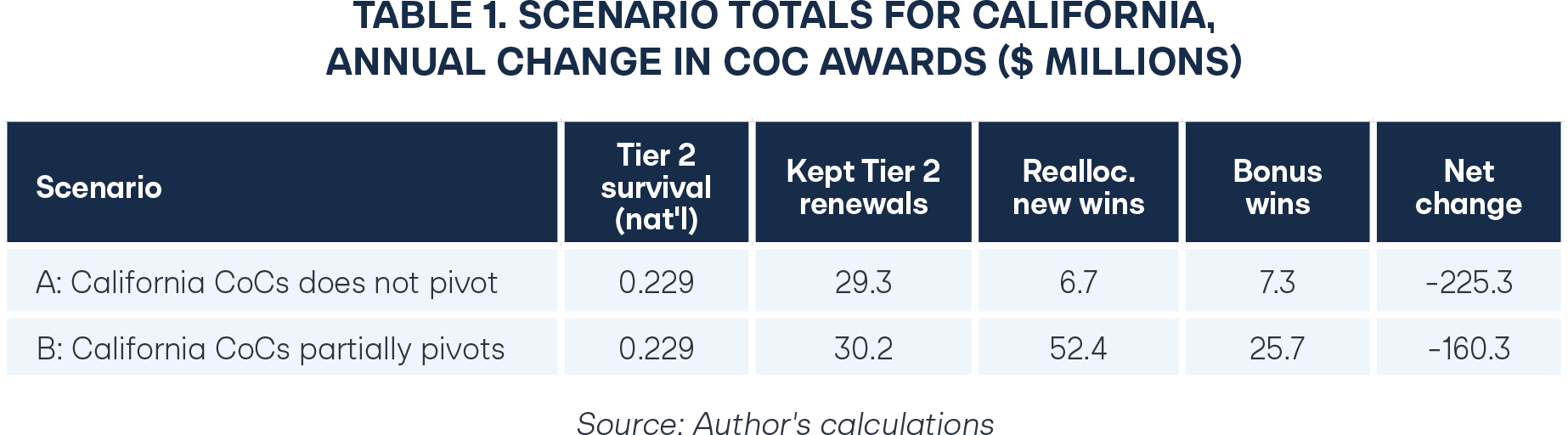
California’s exposed Tier 2 renewal demand is $268.6 million per year: 40 percent of a $671.5 million ARD, of which $402.9 million sits protected in Tier 1.52 Under Scenario One, the state keeps $29.3 million of Tier 2 renewals, recovers $6.7 million through token reallocation and $7.3 million through the bonus, and nets a loss of $225.3 million per year, 33.5 percent of renewal demand.53 Under Scenario Two, the recovery channels grow to $52.4 million (reallocation) and $25.7 million (bonus), and the net loss narrows to $160.3 million per year.54
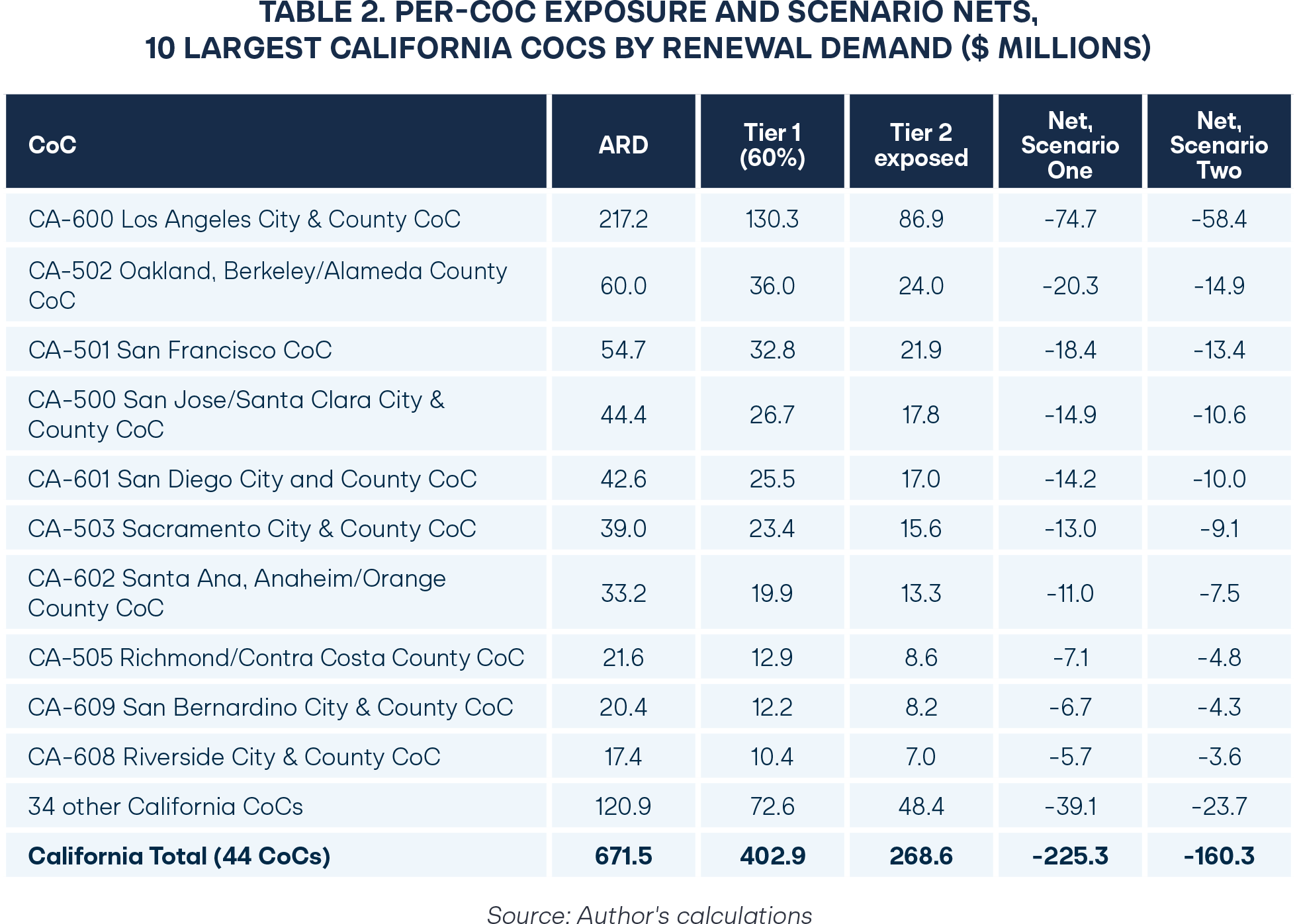
Los Angeles City and County (CA-600), with a $217.2 million ARD, carries $86.9 million of Tier 2 exposure and a Scenario One net loss of $74.7 million, one-third of the statewide total.55 The next four largest exposures are Oakland and Alameda County, San Francisco, San Jose and Santa Clara County, and San Diego, each with Scenario One losses between $14 million and $21 million.56
Other Considerations
This analysis is based on existing data on award history, annual renewal demand, and an independent analysis of HUD’s FY2026 NOFO. It cannot possibly determine how individual CoCs will respond to the NOFO, what the state or counties will do, and how HUD will review applications. It is intended to serve as an initial analysis, given California’s history of investing in permanent supportive housing, its own funding requirements that support the Housing First approach, and the changes to the CoC Program NOFO priorities.
As of publication, HUD is being sued over the changes it has enacted to the CoC Program. This analysis does not contemplate what the court may do in adjudicating each case. In addition, HUD has suspended the Los Angeles Homeless Services Authority as the collaborative applicant for the largest and most funded CoC in the country. HUD has directed providers to apply directly to HUD to be considered for funding under the FY2026 NOFO. A lawsuit brought by LAHSA against HUD for this suspension may thwart HUD’s attempt to fund providers directly.57 This may significantly change funding for the Los Angeles Continuum of Care and its providers.
Conclusion
HUD’s FY2026 Continuum of Care NOFO is the single largest policy change in homelessness assistance in more than a decade. That NOFO contains new policies, new priorities, and new opportunities for Continuums of Care to rethink, reorganize, and renew their approach to homelessness and homelessness assistance. How CoCs respond and how HUD will score and provide awards based on the new NOFO will impact every community in the nation.
California, because of its commitment to Housing First, its history of heavy investment in permanent supportive housing, and its saturation of local and state systems with the Housing First approach, finds itself in a position where it could lose between 25 and 30 percent of its federal homelessness assistance funding. California’s CoCs could continue to apply for federal CoC funds with the same mix of permanent supportive housing, the same commitment to Housing First, and the same rejection of sober living and recovery housing as in the past. They could also respond to the NOFO’s new priorities and funding limits within the constraints of state funding and programming requirements. This analysis puts the potential losses of California’s CoCs collectively at between $225 million and $160 million in federal awards per scenario.
Appendix: Model Specification and Data
Inputs
Per-CoC annual renewal demand, planning, and pro rata need for all 388 CoCs come from HUD’s FY 2025 CoC Estimated Annual Renewal Demand Report, extracted to data/processed/ca_ard_fy2026.csv and data/processed/national_percoc_ard.csv.58 California component composition (PSH, RRH, TH, SSO, and related) comes from the FY2024 award comparison report, extracted to data/processed/ca_coc_components.csv.59 The FY2023 report supplies the prior-year composition rows.60 All NOFO constants were verified against the cached June 1, 2026 NOFO text: total funds ($4.04 billion, p. 6), Tier 1 (60 percent of ARD, pp. 36 and 90), the $1.3 billion new-project set-aside and cap (pp. 35-36 and 89), selection order (pp. 88-90), bonus bounds (pp. 11-12), and scoring (pp. 69-79 and 90).61
Equations
Per CoC i with renewal demand ARD(i). Tier1(i) = 0.60 × ARD(i); exposed Tier 2 renewal demand T2(i) = 0.40 × ARD(i). National Tier 2 renewal survival p = (4,040.0 − 159.6 planning − 5.4 UFA − 2,143.4 Tier 1 − 104.0 DV floor − 1,300.0 new projects) / 1,428.9 = 0.229, all in $ millions; alternative subscriptions of the new-project pool give p = 0.579 at $0.8 billion and p = 0.439 at $1.0 billion.62 Kept renewals = p × θ × (1 − s) × T2(i); reallocation wins = w × s × T2(i); bonus wins = b × cap(i), where cap(i) = min(max(0.15 × FPRN(i), $0.5M), $5M) and FPRN(i) is approximated as max(PPRN(i), ARD(i)). Net(i) = kept + reallocation + bonus − T2(i); scenario A imposes Net(i) = 0.
Parameters
Scenario B: θ = 0.5, s = 0.05, w = 0.5, b = 0.10; scenario C: θ = 0.7, s = 0.30, w = 0.65, b = 0.35; both use full $1.3 billion subscription and no family-floor top-up.63 θ reflects the score deficit in section 2.5; s and w reflect the lock-in in sections 2.3 and 2.4; b reflects California’s below-share position in the bonus-cap distribution described in section 6. The sensitivity table sweeps effective survival p × θ over 0 to 0.35 and total capture over 0 to 0.50 of exposed Tier 2 dollars, spanning every parameter combination the scenarios use.
Reproduction
The companion repository contains the fetch scripts, every cached source with a SOURCES.md manifest per topic, the extraction scripts, the model, and all output tables; a single make command regenerates data/processed and outputs from the committed raw inputs, and model/params.py annotates each constant with its source page.64

Stay Informed
Sign up to receive updates about our fight for policies at the state level that restore liberty through transparency and accountability in American governance.