
Fiscal Transparency in Nonprofit Grantmaking


Introduction
Every dollar the government spends belongs to the public. That principle has driven decades of open-records law, budget transparency portals, and data-standards reform. It applies with equal force whether the government expends funds directly or routes them through third-party intermediaries. The Cicero Institute has established a benchmark for evaluating states’ fiscal transparency based on end-to-end visibility from appropriation to award to payment to audited outcome, with machine-readable data, joinable identifiers, and enforceable statutory mandates. That standard, when used to analyze direct government expenditures from payroll to vendor payments to purchase orders, revealed wide variation in how well states disclose their own spending.1
Yet one of the largest intermediary channels in American public finance operates almost entirely outside of the scrutiny that now governs direct government expenditures: the roughly $300 billion in annual grants that federal, state, and local governments award to nonprofit organizations.2 Despite the scale of publicly financed nonprofit activity, this channel of distributing funds has received limited sustained attention in public discourse in comparison. Recent investigative reporting has begun to document both the magnitude and complexity of public grantmaking, and in turn, its vulnerability to corruption and mismanagement.3,4,5 Reports have uncovered multiple concerning cases including a grant manager awarding funding without any documentation and then leaving to consult for the awarded nonprofits.6 Another alarming case involved a state taking over $850,000 in federal “funds to decrease HIV infections” and distributing it to three nonprofits that, over a five-year period, collectively administered only 35 HIV tests.7,8
When state transparency systems are weak, gaps in accountability for primary and subrecipient grantees emerge, exposing state appropriations and federal pass-through dollars to misuse. This structural blind spot may persist if states lose visibility when public funds cross into the nonprofit grant channel, even for states that score well on direct-expenditure transparency.
This brief extends Cicero’s transparency standard to nonprofit grantmaking. It examines why grants present accountability challenges distinct from direct contracting, documents recent state-level failures that illustrate the cost of weak grant transparency, surveys the reporting frameworks of states that have begun to close the gap, and proposes an aligned set of standards. These recommendations include machine-readable disclosure, timely recipient and subrecipient reporting, outcomes-linked evaluations, and enforcement tied to tax-exempt status to hold nonprofit grantmaking to the same transparency standards as direct public expenditure.
The Cost of Limited Grant Transparency: State-Level Failures
With direct and indirect expenditures alike, “opaque systems allow governments to shift expenditures off-budget, underreport debt, accumulate arrears, or optimistically forecast to mask deficits.”9 Cross-country analyses by Benito and Bastido (2009) and Khagram et al. (2013) further find that improved accountability measures, which rely on sufficient transparency, reduce government corruption.10,11 Therefore, transparency created in an effort to prevent waste ensures that states function at a higher level of performance.
The audit cases that follow are not isolated incidents of nonprofit misconduct. Each represents a state grant program in which the absence of transparency mechanisms allowed misuse, mismanagement, or measurable failure to escape detection until significant public funds had already been lost.
Waste
Waste: the thoughtless or careless expenditure, mismanagement, or abuse of resources to the detriment of the U.S. government. Waste also includes incurring unnecessary costs resulting from inefficient or ineffective practices, systems, or controls.12
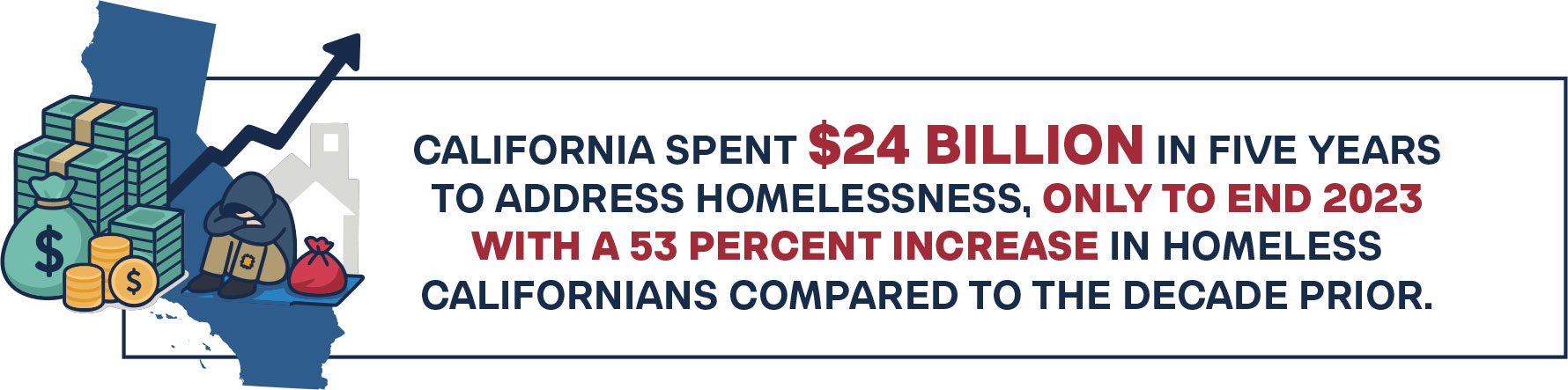
California spent $24 billion in five years to address homelessness, only to end 2023 with a 53 percent increase in homeless Californians as compared to a decade prior.13 While factors beyond poor grant performance or inefficient spending may have contributed to this increase, the California Interagency Council on Homelessness (Cal ICH) conducted only one comprehensive funding and outcomes assessment during the period reviewed from FY18-FY20, and has not updated that assessment since 2021, leaving the State unable to evaluate billions of dollars in subsequent spending. For three of the five programs reviewed by the auditors, collectively funded at more than $9.4 billion, it could not be determined whether public funds were used soundly due to incomplete or entirely absent outcome data.14 Cal ICH lacked a consistent method for gathering cost and outcome information across the State’s more than thirty homelessness programs. The data it did collect was of undetermined reliability, with shelter enrollment records exceeding bed capacity by nearly four times in at least one case. In the face of rising rates of homelessness, the State Auditor notes “Cal ICH has also not aligned its action plan to end homelessness with its statutory goals to collect financial information and ensure accountability and results.”15
In Minnesota, the Behavioral Health Administration (BHA) within the Department of Human Services overpaid two grantees by nearly $42,000 without identifying the error until auditors flagged it.16 BHA did not consistently collect required progress reports, perform required monitoring visits, or complete financial reconciliations. Each of these failures had been identified in prior audits and remained unresolved.
Beyond waste, the Minnesota’s Behavioral Health Administration (BHA) program case exhibits clear signs of fraud and abuse. Particularly alarming was the lack of documentation for services provided in the over $672,000 paid to a single grantee for their first month of work, and the BHA manager who approved the grant leaving to consult for that grantee shortly afterward. When auditors requested documentation, BHA staff backdated and created records that did not previously exist.
Fraud
Fraud: the wrongful or criminal deception intended to result in financial or personal gain. Fraud includes false representation of fact, making false statements, or by concealment of information.17
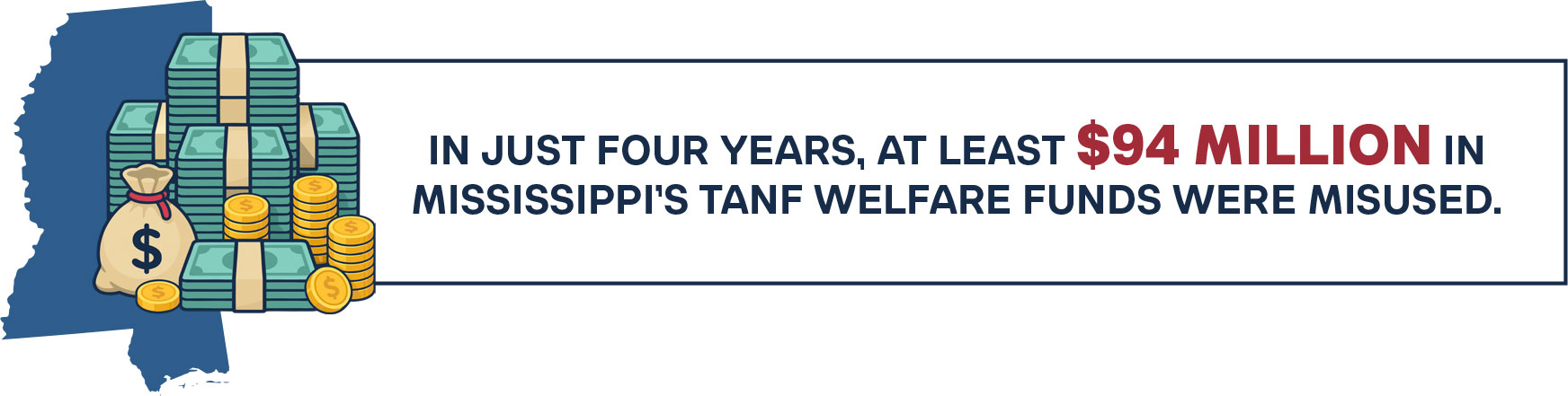
Between 2016 and 2020, at least $94 million in Mississippi’s TANF Welfare funds were misused, in what the State Auditor described as the largest public embezzlement case in state history. The director of Mississippi Department of Human Services awarded these federal welfare block grants to two nonprofit organizations: the Mississippi Community Education Center (MCEC) and the Family Resource Center of North Mississippi (FRC).18 It was announced in 2022 by the DOJ that these organizations awarded contracts to various entities for services that were never provided. While TANF funds are explicitly prohibited from being used for capital projects, $5 million was used to build a “Wellness Center” volleyball facility where Brett Favre’s daughter played. $1.1 million was paid to Favre Enterprises for speeches Favre never gave. The magnitude of fraud discovered in this case was the result of multiple systemic failures. Limited oversight of funds allowed Director John Davis to “unilaterally decide when grants were awarded and for how much.” The Mississippi State Auditor Shad White testified before Congress in 2023 that the Department of Human Services were “not monitoring its subgrantees, its nonprofits, to ensure that the dollars were reaching needy folks.”19 The state of Mississippi lacked the ability to follow money once it reached the awardee. As a result grant funds that were intended to assist those in need were stolen from both taxpayers and communities.
Concerns with Connecticut’s grant approval process and fiscal transparency were brought to the forefront in early 2026.20 An audit was launched after the Blue Hills Civic Association (BHCA) reported to the Department of Economic and Community Development (DECD) that it lost $300,000 in state funds. On two occasions, BHCA wired funds intended for the same subgrantee to a fraudulent bank account. The audit concluded that BHCA received more than $15 million in state funding even as “MOUs were frequently backdated, passthrough arrangements lacked transparency, and significant discrepancies in reported expenditures went unchallenged.”21 “Pervasive governance failures, systemic internal control weaknesses, and patterns of conduct that strongly suggest potential fraud and misappropriation of public funds” permitted an additional $200,000 in unsupported disbursements. With unregulated oversight, and poor transparency standards, BHCA was able to receive state funding for multiple years with no consequences.
Abuse
Abuse: excessive or improper use of a thing, or to use something in a manner contrary to the natural or legal rules for its use.22
Between 2020 and 2025, Mississippi Department of Health distributed $853,000 in federal pass-through funds to three nonprofits to expand HIV testing. Over those five years, the three nonprofits administered 35 HIV tests total.23 The Immigrant Alliance for Justice and Equity (IAJE) spent $17,380 on a “Queerceanara,” including alcohol, gift cards, and event expenses, along with additional charges for spa gift baskets, rideshares to a lesbian bar, and a meal linked to a tobacco/vape storefront. The state’s approved scope of work for Love Inside for Everyone (LIFE, Inc) included that they ought to “hire at least (1) Community Health Workers that identifies as Gender Non-Conformant (GNC), Aged 17–34 that are People with HIV (PWH), members of the community, and or at risk for acquiring HIV to provide agreed upon services.”24 LIFE later reported over $90,000 in undocumented expenditures, and used grant funds for monthly “diva brunches” at a nightclub operated by its director.25
Why Grants Merit A Novel Transparency Standard
The effectiveness of grant dollars depends on the visibility of the underlying transactions, and though grant funding is structurally a different instrument from direct expenditures, the associated transparency measures ought to mirror the previously established benchmark.
Grants, however, present three features that extend beyond direct expenditure, each occupying a distinct point in the grant lifecycle. When grants are awarded, grantees operate with broader discretion than contractors over how appropriated funds are used. When funds are disbursed, public funds frequently pass through multiple layers of subrecipients, a structure that federal regulation explicitly contemplates and that the Government Accountability Office has identified as a persistent source of oversight failures.26 When assessing results, paperwork compliance is not sufficient to determine whether legislative intent has been realized.
Recipient Discretion
When an agency awards a grant to carry out a public purpose, the recipient exercises considerably broader discretion than a vendor would over how that purpose is pursued.27 A grant to improve reading rates among fourth graders or to expand access to behavioral health services often leaves the specific activities, prioritization among populations served, and intermediate milestones to the recipient’s professional judgement. This flexibility makes grants suitable for complex public purposes such as research, social services, and community development, and is the reason legislatures choose to fund through grants in the first place.
This is a feature of the grant instrument, and it also means the concept of an output is fundamentally different for grants than for contracts. A contract output is a unit of property or service that can be inspected and counted against the agreement. A grant output is a measurable change in the conditions the appropriation was meant to address, and verifying it requires a framework that links discretionary activity back to the appropriated purpose.
Subrecipient Layering
When states and localities allocate substantial resources through channels beyond direct expenditure, these layered structures can quickly diffuse responsibility and complicate oversight. A primary recipient may pass funds to subrecipients, who in turn may engage further parties to carry out specific program activities. Each subrecipient only further distances activities from the original award, reducing the likelihood that the state can see the final use of the funds. Beyond their own funds, states serve as stewards of substantial federal pass-through funding, such as block grants, formula grants, and reimbursement programs that flow through state agencies to nonprofit subrecipients. To protect both state and federal taxpayer resources, a strong and granular transparency framework is necessary to prevent malicious actors from remaining paperwork compliant on the surface while routing funds toward purposes inconsistent with the original appropriation.
Outcome Ambiguity
Some grant purposes, particularly basic research and capacity building, produce outcomes that are diffuse, have a long horizon, or are qualitative such that they require proxies or longitudinal evaluation rather than direct metrics. The exception, however, is narrower than current practice would suggest. Service delivery, behavioral health, education, and workforce programs all have well-established outcome metrics in the evaluation literature, and the current absence of standardized outcome reporting reflects the lack of frameworks requiring it rather than any inherent difficulty in measurement.28,29,30
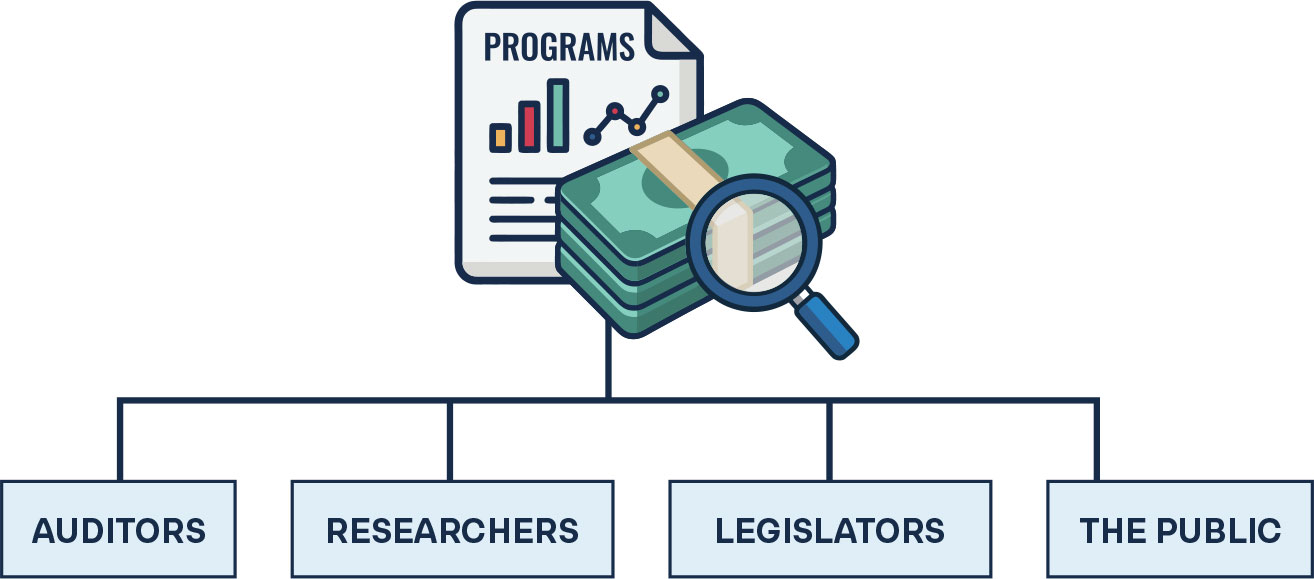
Improved outcomes disclosure allows auditors, researchers, legislators, and the public to assess how public dollars translate into program results. Grants with outcome based performance metrics additionally provide the groundwork for incentive-based funding. This enables successful nonprofits to increase their credibility, and for resources to be redirected towards these organizations with strong demonstrated performance and likelihood of achieving intended goals.
Policy Recommendations
Translating Cicero’s existing A Standard for Fiscal Transparency in Government to public grantmaking, the following seven steps to increase fiscal transparency improve efficiency of grants and decrease misuse of funds:
1. Standardized, Human-and Machine-Readable Financial Reporting
Clean, consistent data gives legislators, agencies, and the public insight into how current grant funds are deployed and the historic records of how legislative intent was achieved via nongovernmental organizations. The same set of data elements should be clearly enumerated for all agencies, such that every agency awarding grants will collect and maintain the same minimum data elements for each award, and in machine-readable and bulk-analyzable formats (e.g. XML, CSV). Every disbursement should generate a traceable record, and nonprofits reporting data should do so in a format that can be easily analyzed and incorporated into the agency’s recordkeeping system. Standardization enables cross-agency comparison, database integration, and multi-year trend analysis. Ambiguity about what must be disclosed remains the leading cause of thin or inconsistent transparency portals.31
Data alone is not self-interpreting. Statutes should require publication of methodological notes and dataset documentation in both human-and machine-readable form, so that watchdogs, journalists, auditors, and researchers can validate and reproduce findings drawn from the data.
Standardized, machine-readable reporting can be a real undertaking for smaller recipients. Standardization efforts often assume system compatibility between agencies, vendors, and nonprofits, when in practice these tools frequently do not interoperate, and smaller nonprofits in particular may lack case management or reporting software, instead tracking their activities in manually maintained and idiosyncratically organized spreadsheets. Rather than requiring every recipient to adopt sophisticated infrastructure, the state-side system should accept data in formats recipients can actually produce.
Example:
Mississippi’s House Bill 1171 will take effect July 1, 2026, with updated agency policies required by January 1, 2027.32 The Department of Finance and Administration, in coordination with the Department of Information Technology Services, is directed to develop an automated tool that converts submitted financial data into a consistent, machine-readable format, enabling the cross-agency and multi-year analysis Mississippi’s prior summary-level portal could not support.
Example:
Illinois established one of the most centralized and standardized state grant systems through the Grant Accountability and Transparency Act (GATA), designed to improve consistency, oversight, and transparency. All state grant funding is processed through a unified statewide system. Standardized rules apply across agencies rather than agency-specific grant procedures. This centralized registration system tracks application status, award decisions, subrecipient relationships, and compliance status.33
2. Joinable Identifiers Enabling Program-Level Spending Transparency
Disaggregating spending by specific agencies and programs is crucial for eliminating grant waste and corruption. Many nonprofits report program services as one large sum, but fail to provide specific program cost breakdowns or outcome-aligned budgeting. If nonprofits are required to report individual expenses and tie them to unique programs, agencies can evaluate outcomes. Invoicing with granular expense records permits patterns of corruption or funding misuse to be more easily brought to light.
Recognizing that many nonprofits serving clients braid funding together to address needs holistically by providing multiple eligible services, contracts should nonetheless require that all funds can be traced back to their source. Program-level disaggregation is only meaningful if each expense can be traced upstream through the full grant accountability chain. A nonprofit’s program expenditure must link to the specific grant award that funded it; that award must link to the agency program from which it was disbursed; and that program must link to the originating legislative appropriation. This requires persistent identifiers carried throughout the chain: a canonical appropriation code, a unique award identifier, a recipient identifier persistent across awards, and a transaction identifier on every disbursement.
Example:
Under Mississippi’s House Bill 1171, every primary recipient and subrecipient must undergo an annual GAGAS-compliant audit by or under the State Auditor, with risk-based scoping permitted. Audit schedules must be delivered in machine-readable format and include every state-fund payment with date, amount, description, vendor, and persistent identifiers, revenues by source, a full subrecipient schedule, and related-party and conflict-of-interest disclosures. Reports, management letters, and corrective action plans are published on Transparency Mississippi and transmitted to legislative leadership.34
3. Timely Reporting
Federal grant programs report financial information on a schedule between annually and quarterly, with the federal agency or pass-through entity collecting the associated financial reports.35 States should implement equivalent reporting cadences for grants administered with state funds. IRS form 990 filings often become public 12 to 18 months after the fiscal year ends, providing organization-wide, rather than program-level information. State grant transparency should not depend on form 990 disclosures; award recipients should report directly to the awarding state on a quarterly or semiannual basis, with reporting cadences tied to disbursement schedules so that late reporting carries a concrete financial consequence. This will further enhance the ability of a state to prioritize funding, divert it away from underperforming awards, and flag incidents of potential corruption sooner.
Example:
California requires quarterly expenditure reports and final performance reports before final disbursements are released. The disbursement linkage is a strong enforcement mechanism, as late reporting has a real financial consequence.36
4. Uniform Standards for Handling Risk and Independent Auditing
Audit quality varies substantially across nonprofit grant recipients. State frameworks should require uniform audit standards for every recipient of public funds, regardless of award size, including standardized financial reporting templates, clear separation of administrative and program costs, and risk-based monitoring scaled to award size and prior compliance history. Third-party audits should be required above a designated revenue threshold; below it, for smaller nonprofits where the cost of a third-party audit would meaningfully detract from the value of the grant itself, the state auditor’s office could allocate resources to conduct a limited number of these audits directly. Audit reports, management letters, and corrective action plans should be published for the public alongside the underlying financial data.
Financial audits verify the accuracy of an organization’s financial statements; management and control audits, by contrast, assess whether an organization’s internal systems and processes are functioning as intended, and are particularly useful for identifying the systemic weaknesses that allow misuse to go undetected in the first place. States should require both, calibrated to a risk-based monitoring framework.
Executives and board members of applicant organizations should file sworn disclosures of influence over grant appropriations, recent leadership at organizations found in violation of state grant requirements, and any financial crime convictions. States should maintain a confidential whistleblower channel published on the same data portal, with protections extending to nonprofit employees, grant administrators, and recipients who in good faith report misuse of public funds.
Example:
The Illinois Grant Accountability and Transparency Act (GATA) explicitly mandates risk assessments, monitoring plans, and mirrors federal standards. Grantees are scored against a standardized Internal Controls Questionnaire and assigned a risk level to determine monitoring intensity, with new grantees and those with prior compliance issues receiving more intensive oversight than established grantees with clean track records. GATA covers specific auditing standards, indirect cost treatment, and separation of administrative versus program costs.37
Example:
Mississippi HB 1171 requires board and leadership disclosures and additionally prohibits grant preference based on political affiliation, ideological orientation, or organization type absent statutory or programmatic requirement.38
5. Connecting Budgets to Performance Metrics
Nonprofits must be able to link funding to tangible, quantifiable outcomes or, in the case of capacity-building or exploratory projects, appropriate objectives or milestones. Instead of merely reporting dollars spent within a fiscal year, nonprofits must be able to articulate what outcomes were achieved with awarded funds such as the number of individuals served, percentage reductions in homelessness, or job placement rates. Outcomes should be defined at the time of award, reported against during the grant lifecycle, and tied to renewal decisions. Linking funding to results ensures effective nonprofits are given the tools to achieve community goals, so communities thrive and corrupt organizations falter with no financial backing.
Example:
The Colorado State Measurement for Accountable, Responsive, and Transparent Government (SMART) Act ties grant program renewal to outcome data. Programs with poor closeout performance lose priority in future cycles.39
6. Public Accessibility and Usability of Grant Data
Taxpayers ought to have visibility into how public funds are appropriated and deployed in the public interest. Increased visibility supports government credibility and connects citizens to the democratic process, but its more important function is providing watchdogs, journalists, and researchers with the data necessary to hold representatives and agencies accountable.40,41
A grants portal can be incorporated into a state’s existing direct expenditures portal or function independently, with each agency hosting its own. In either configuration, the portal should:
- Link every payment to a nonprofit recipient to the specific grant award and the originating legislative appropriation, through downloadable machine-readable and comprehensive datasets containing standardized identifiers.
- Maintain a centralized catalog of the agency’s active grant programs, including program descriptions, eligibility criteria, funding amounts, reporting requirements, and application procedures.
- Publish the full text of every grant award document, including the executed agreement, scope of work, deliverables, performance clauses, pricing schedules, and all amendments and change orders, with narrow, reviewable redaction permitted only for statutorily protected content.
- Pair financial data with performance metrics, outcome data, and other associated reporting so that spending and results can be evaluated together.
- Link directly to each recipient’s available grant term sheets, website, associated project reports, and archived historic 990 filings.
- Prioritize interface usability so that the data is accessible to non-technical users.
In addition to state disclosure requirements, nonprofit recipients with a public website should post an aggregate breakdown of their funding between private donations and government funds, with the latter broken out by level. A nonprofit unable to comply may apply to the awarding agency for a public exemption.
Example:
Florida has made meaningful progress with its publicly searchable grant disbursement data under the Transparency Florida Act.42 This portal includes: deliverables with associated performance metrics and financial consequences, individual payments, all contract and amendment documents, associated audits, contract amount payment to date, vendor name, agency name, contract type, date of execution, agency service area, statutory authority, recipient type, method of procurement, if any advanced payments were authorized, and grant disbursement changes and rationale. It is important to note that, although Florida currently represents one of the strongest examples of public accessibility and fiscal transparency, the platform continues to face challenges related to compliance, bulk downloads, and data join links.
Example:
Illinois’s Catalog of State Financial Assistance (CSFA) is a statewide database of all grant programs and includes program descriptions, administering agencies, and reporting requirements. This provides a single reference point for understanding all state grant opportunities.43
7. Establish an Enforceable Compliance Regime Tied to Tax-Exempt Status
Transparency standards without enforcement become aspirational rather than operational. The same infrastructure that gives the public visibility into grant spending also produces the structured records that make fraud detection possible: pattern recognition, vendor concentration analysis, and cross-program comparison depend on standardized, accessible data.
Receiving appropriated funds from state governments comes with the responsibility of stewarding public funds. Nonprofit grant recipients are accountable not merely to donors but to the public at large. Recipients that fail to meet standardized reporting requirements, or whose audits surface material misuse, should face graduated consequences at progressive levels of severity:
- A required fiscal transparency corrective plan within 100 days;
- A third-party audit and full financial reconciliation at the recipient’s expense;
- Ineligibility for state and federal grant awards for a defined period;
- Revocation of state tax-exempt designation; and
- Referral to the Internal Revenue Service for review of 501(c)(3) status in cases of sustained or material noncompliance.
Tax-exempt status is a public benefit conferred on the premise that nonprofit activity serves public purposes; recipients that fail to operate transparently against that premise should not retain the benefit indefinitely. This tier requires no new federal authority, only that state attorneys general and grant-making agencies refer documented cases of sustained transparency failure or material misuse to the IRS under existing 501(c)(3) revocation procedures.44
Conclusion
Nonprofit grant funding represents a large channel of public spending in the United States yet lacks transparency and reporting measures. As grant opportunities grow, so does the need for stronger accountability systems that connect funding to outcomes. Louis Brandeis, known for his admonition that “sunlight is said to be the best of disinfectants,” later in the same essay notes that for public oversight to be real, “disclosure must be real. And it must be a disclosure to the [relevant public body]. It will not suffice to require merely the filing of a statement of facts with the Commissioner […] or with a score of other officials, federal and state.”45
States can bring grant funding into the light by making grantmaking records transparent to the public via: standardized and machine-readable reporting, transaction-level tracking from appropriation to expenditure, independent auditing scaled to award size, and outcome-based evaluation tied to renewal decisions. The case studies in this brief illustrate what the absence of such standards costs. They also illustrate that where transparency infrastructure is weak, public funds become vulnerable to waste and fraud regardless of the program’s stated purpose or the recipient’s stated mission.
The administrative costs of implementing transparency standards are a fraction of the public funds currently lost to inadequate oversight. Transparency is necessary to ensure the public’s interests are being realized when public dollars are being directed, via efficient government processes, to support legitimate nonprofits. In a country that is consistently making efforts to improve transparency, nonprofit grant funding must not go unaddressed. To rebuild public trust, protect taxpayer resources, and strengthen nonprofit performance, state level fiscal transparency standards must be implemented throughout the United States. In the 21st century, fiscal transparency is essential for both effective governance and a strengthened democracy.

Stay Informed
Sign up to receive updates about our fight for policies at the state level that restore liberty through transparency and accountability in American governance.