
The Case for Opt-Out Court Notification Systems

Scope of the Problem
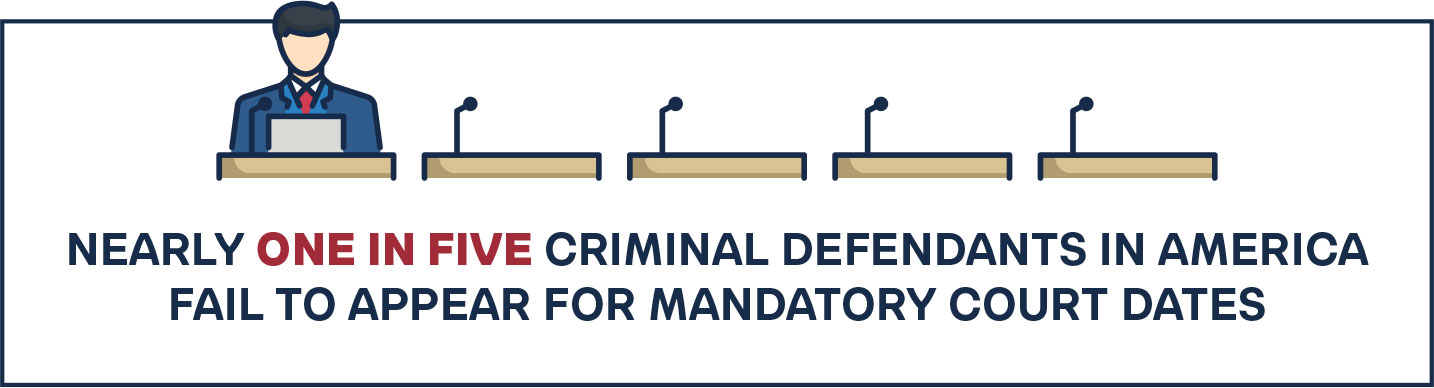
Nearly one in five criminal defendants in America fail to appear for mandatory court dates, although the rate varies by jurisdiction and type of offense.1–2 In Lafayette Parish, Louisiana, 52 percent of defendants in traffic court fail to appear for a court hearing. In other jurisdictions, like Louisville, Kentucky, only 13 percent of cases released from pretrial missed a mandatory court date.3–4 Regardless of these variations, the problem is pervasive.
The pervading belief is that individuals who fail to appear are both dangerous and intentionally absconding from court proceedings.5 The available data, though, suggests a different scenario. Research has found that those charged with serious offenses are less likely to miss court. In one study, people accused of violent crimes missed court in just 13 percent of cases, whereas people charged with property, drug, or public order offenses missed court in 87 percent of the cases.6 Additional research indicates that failure to appear is most common in traffic court, particularly in cases involving administrative violations like not having insurance or having expired tags (about 30 percent).7 A study in North Carolina found that 85 percent of missed court dates were for traffic misdemeanors.
The reasons behind missing court might also be more benign than absconding. An anonymous poll of U.S. adults with previous court involvement found that “unaware of the court appearance” was the single most common reason reported for missing a court hearing (accounting for 32 percent of all responses), followed by a “lack of transportation” (28 percent) and “forgot the court date” (19 percent).8 Meanwhile, just eight percent of respondents said they didn’t show up because they were “afraid of going to jail.” While self-reporting data is not always reliable, the findings suggest that absent or ineffective communication from the court and legitimate constraints on the court user may be key contributors to missed court dates.

These figures indicate that most missed appearances do not reflect cases that may have a substantial risk to public safety, yet they create a significant burden for law enforcement. A statutory review of all 50 states found that:
a) most states allow for the issuance of a bench warrant for missing court
b) most states automatically suspend a driver’s license, and
c) most states categorize failure to appear as its own crime.9
These penalties are not just hypothetical; multiple studies show that law enforcement is tasked with arresting and booking people for missing court, even though the underlying charge may not have had incarceration as a potential punishment (like a traffic violation).
For example, more people are arrested for failing to appear in Michigan than for Driving Under the Influence and Assault/Battery combined.10 Further, in North Carolina, the most common reason for jail booking was a failure-to-appear warrant for an underlying misdemeanor charge. These failures to appear accounted for about one in six jail bookings in the jails studied.11
Beyond the time and resources of law enforcement, court operations are slowed down when someone misses court.12 Clerks may need to handle additional paperwork like issuing warrants or rescheduling cases, judges and attorneys may waste time in the courtroom, and victims and witnesses may be inconvenienced in some cases. In sum, failure to appear cases represent an undue burden on the criminal justice system.
Cost of Failure to Appear
Both direct and indirect costs are incurred by the criminal justice system when people fail to appear in court. The direct costs (e.g., costs associated with jail time, courtroom workgroup costs, arresting officer time, and transportation) to the criminal justice system are estimated at approximately $1,500 for every instance of failure to appear.13 In New York City, 25 percent of people miss court due to traffic delays. This means that of the 109,393 arrests in New York City in 2023, 27,348 were for failing to appear, at a total cost of $41,022,375.14 Given a conservative 17 percent average failure-to-appear rate nationally, roughly three million of the 17 million total annual court cases fail to appear. The result is $4.5 billion in costs to the local and state governments.15 Individuals who miss court do not fare much better, losing an estimated $1,354 for each case in bail, lost wages for a total of roughly $4.1 billion.16

Benefits of Court Date Notifications
Researchers have explored dozens of innovations—both in policy and practice—intended to address missed court hearings, from offering transportation to creating more streamlined scheduling.17 The intervention with the most robust body of research behind it is court date notifications, which remind an individual about an upcoming court hearing.
Reminders are a common practice for doctors’ offices and other appointment-based small businesses. They were tested and studied in courtrooms as early as 2005, in Multnomah County, Oregon.18 In that case, and in other early court reminder studies, automated or live phone calls were a common way of notifying someone of a court date and were consistently shown to be effective.19 Nebraska uses a postcard format that decreased failure to appear by up to 22 percent.20
Text messages are increasingly becoming the preferred method of communication for the public, and notifications have shifted accordingly. Newer studies utilizing text messages, which have more rigorous standards including randomized controlled trials, have shown them to be successful. Across four such studies, text message notifications reduced missed appearances from 20 to 40 percent.21 These findings for text message notification are consistent with other reminder modes. A recent meta-analysis of court reminder research found significant improvements in 11 of 12 studies, regardless of the method of the reminder.22
Research has even dug into the details of the messages themselves. In a New York City study, researchers tested different messages that were texted to defendants. They found that messages that reference the consequences of missing court (like the risk of arrest) and encourage individuals to plan to get to court on time were even more effective at reducing no-shows than a neutral message.
Current Utilization of Notification Systems
States underutilize the systems that notify individuals of upcoming court hearings. Only 18 states and Washington, D.C., currently have statewide notification systems using mail, email, or phone-based notifications. Ten other states have systems that cover some jurisdictions, usually involving city centers. Still, 19 states and many jurisdictions (especially in rural areas) do not have a reminder program at all.23
Even in states that have a notification system, policy choices have reduced its effectiveness. For example, noncriminal cases (e.g., civil, family, or traffic matters) are rarely eligible to receive reminders, and some programs only offer them to a subset of criminal cases. This is a clear area for improvement that may lead to greater satisfaction with the court process.
Secondly, states are inconsistent in how they enroll individuals in the program. Most use opt-in systems, meaning an individual must sign up to receive reminders through the program. This is often done through a website, but in some places, signing up means a paper form needs to be shared with the court. Opt-in enrollment typically leads to lower usage and participation in the program.24 The public might not know a program exists, it may be confusing or time-consuming to sign up, and the individuals who most need reminders are not necessarily the ones who seek out services. Participation in opt-in programs ranges from two percent to 30 percent of all eligible cases, meaning just a small percentage of individuals who are able to get a reminder receive one.25
Some states automatically enroll individuals to increase participation and impact. These states use an opt-out notification system, meaning all individuals eligible to receive reminders are enrolled in the program unless they choose to stop receiving reminders. New Mexico and Arizona, states that both leverage opt-out enrollment, have much higher participation rates, 72 percent and 90 percent, respectively.26 In these states, millions more people who are eligible for reminders will receive them. Opt-out, text-based court notifications are not only more effective but also represent a more efficient use of funds for the return on investment.
Costs of Court Reminder Programs
One study of six states found initial setup costs for a state’s court reminder program ranged from $35,000 to $600,000.27 The cost for individual states will vary based on their circumstances, but the biggest determining factor might be the state’s software and case management system. If a state already has a statewide case management system with sufficient technological abilities, adopting a court reminder program will be easier and less expensive than in states with poor or decentralized technology.
Adopting a court reminder system is still possible even in states with a decentralized court system or limited technological capacity. Texas has more than 100 counties and a decentralized court system, but it recently passed legislation to offer court date reminders statewide by employing a vendor to handle the implementation.28
Depending on the state’s needs and capacities, there are three approaches to successfully setting up and implementing a court reminder program. First, the program could be added as a feature to software already being used. Larger case management system vendors likely have a feature for court reminders, but it comes with an additional expense.
Second, IT staff within the court can build and maintain a custom reminder system. This approach would be ideal for a state that has already invested in court technology and has the expertise on hand to execute the project. One state reported that setting up their reminder program took two full-time employees and was developed in 60 days. Courts typically pay a vendor such as Twilio to send the text messages for less than a penny ($.0083) per message.29

Third, states can hire an external vendor to set up and maintain the court reminder program from start to finish. These companies specialize in communications platforms and will extract the necessary data, host the program, and allow courts to customize certain aspects (i.e., message content, frequency, language translations). One popular vendor, eCourtDate, typically charges an implementation fee, an annual license fee, and charges per message.30
Conclusion
Opt-out court notification programs provide an opportunity to reduce the number of failure-to-appear warrants and the associated costs to taxpayers. While multiple electronic forms of communication are currently used (e.g., email, opt-in programs, phone calls), none of these methods of court date notification have been shown to have the same reductive impact as an opt-out court notification system. While a state’s unified case management system can help implement a court notification system, it is not required for a successful program. It simply requires an individual to have a valid number where they can receive court notifications via text—and that can easily be accomplished by adding it to the citation. This program presents a responsible stewardship of taxpayer dollars while also mitigating the impact that these failure-to-appear warrants have on an already overburdened criminal justice system. While a state’s unified case management system can help implement a court notification system, it is not required for a successful program. It simply requires an individual to have a valid number where they can receive court notifications via text—and that can easily be accomplished by adding it to the citation. This program presents a responsible stewardship of taxpayer dollars while also mitigating the impact that these failure-to-appear warrants have on an already overburdened criminal justice system.

Stay Informed
Sign up to receive updates about our fight for policies at the state level that restore liberty through transparency and accountability in American governance.