
2026 State Policy Agenda for Telehealth Innovation


Introduction
This year’s Telehealth State Report Card once again showed only incremental progress at the state level in 2025. But with the passage of the One Big Beautiful Bill and its $50 billion Rural Health Transformation Program, states now have both the incentive and the resources to modernize their telehealth laws.1,2
The 2026 legislative session offers a second “big bite of the apple”—the first being COVID-era flexibility—to make long-overdue updates that strengthen access, affordability, and innovation in care delivery. There’s no shortage of work ahead: several states still earn an F on our report card, and only a few score an A. Most states remain far from an innovation‑ready, pro‑patient playing field.
Healthcare affordability continues to be a top concern for families and businesses, yet 25 states still enforce payment parity mandates that make telehealth care more expensive. Many policymakers seem to think that repeating the same approach in healthcare delivery will result in different outcomes. While not all reforms in this report will immediately improve a state’s eligibility for Rural Health Transformation Program funds, they would directly benefit patients and should be part of any legislative overhaul.
Most states lack comprehensive frameworks that enable providers and entrepreneurs across all health professions to redesign care through telehealth. Of the hundreds of bills we reviewed for this report that were introduced in 2025, most focused narrowly on a single provider type and/or imposed a mandate of some kind related to coverage or payment for a telehealth service instead of pursuing broad-based modernization.
Telehealth is not a silver bullet, but it remains one of the most efficient and cost-effective ways to expand access to care, particularly in underserved rural communities. Despite this, many states have done a patchwork job of updating their laws.
Policymakers should view the Rural Health Transformation Program as a once‑in‑a‑generation opportunity to combine rural investment with forward‑looking telehealth reform—rather than reinforcing outdated systems. By pairing funding with modernized laws, states can give rural residents reliable access to specialists, integrated behavioral health, and innovative care teams that support local providers.
This next phase of reform cannot focus only on brick-and-mortar care locations. States need clear, innovation‑friendly telehealth laws for all patient and provider types. The recommendations in this report would help states take the minimum first steps down this path. Too many 2025 bills, however, centered on niche areas like veterinary or cannabis telehealth, or even rolled back pro‑patient flexibilities. To truly serve both rural and urban communities, lawmakers must move beyond incremental change and adopt comprehensive telehealth reforms that expand choice, competition, and patient benefit.
The Rural Health Transformation Program
The Rural Health Transformation Program (RHTP) highlights telehealth reform as a core signal that states are serious about building a more sustainable rural healthcare system. Half of the $50 billion will be distributed based on a competitive scoring methodology that heavily rewards a reform‑minded policy and delivery landscape, not just baseline need. Roughly 30 percent of the total points tied to policy‑related funding can be directly or indirectly connected to telehealth, depending on how aggressively a state bakes telehealth into its initiatives and regulatory agenda; the exact share is not fixed in regulation, but the technical factors create room for a large telehealth “footprint.”3
In the scoring framework, states gain credit for modernizing licensure to allow in‑state exceptions, simple registration, or special licenses for across‑state‑line practice, all of which can support telehealth. The Centers for Medicare and Medicaid Services (CMS) explicitly calls out a goal of using “telehealth support to extend the reach of specialists,” and the evaluation will consider both the share of the population with meaningful telehealth access and the number of encounters delivered remotely.
There is a clear focus on rewarding states that prioritize telehealth. For example, the dedicated “remote care services” funding factor, combined with technology and data infrastructure elements, accounts for a meaningful percent of the technical score for funding and is explicitly focused on telehealth, remote care, connectivity, and related digital tools.
Additional subfactors examining interoperability, consumer‑facing tools, and innovations serving individuals dually eligible for Medicare and Medicaid can all be driven heavily by telehealth and remote‑care innovations. While the program specifically highlights the importance of Medicaid paying for at least certain forms of telehealth, states would be wise to modernize their telehealth statutes across all populations and payers to maximize impact and scoring potential.
Indirectly, provisions related to population health and prevention reward integrated, team‑based care, chronic disease management, and outreach that can be delivered or scaled via telehealth. For example, remote monitoring, digital engagement, care‑delivery innovation, and payment‑incentive factors favor value‑based and alternative payment models that explicitly pay for virtual visits, virtual teams, and remote monitoring, all via telehealth. Scope‑of‑practice changes can further extend telehealth’s reach when clinicians are allowed to practice independently at the top of their license and are clearly authorized to use telehealth modalities instate and across state lines. The RHTP specifically includes scope of practice for nurse practitioners and pharmacists in its technical scoring methodology, meaning that states can increase their federal funding by empowering these medical professionals to practice at the top of their training, and would also improve their grade in our future reports.
Finally, RHTP dollars will stretch further if states repeal or phase out payment‑parity mandates that require telehealth visits to be paid the same as in‑person care. The original rationale for parity was to help providers cover start‑up technology costs, but inexpensive telehealth tools are now widely available, and the RHTP itself offers substantial technology funding. CMS should signal that states are expected to move away from rigid parity requirements toward flexible payment models that reward value rather than visit type.
2025 State Telehealth Trends
States continued a recent trend of introducing a myriad of bills to establish multistate compacts for individual professions, including dentistry, nutrition, and especially social work. This piecemeal approach recognizes the need for greater interstate telehealth access but falls far short of other reform solutions that could remove barriers to access across the board.
As noted in previous reports, a superior approach would be to enact a simple registration bill, enabling patients to quickly access all forms of telehealth through recognized out-of-state providers.4 By contrast, multistate compacts cost more to establish, offer fewer provider options, limit the scope of available services, and take longer to increase patient access to telehealth services.
While no new states have enacted a registration law during the 2025 legislative session, numerous states introduced legislation that would have greatly expanded patient access to out-of-state telehealth providers and raised the state’s innovation ranking, including WI AB212 and SC S377.5,6 If enacted, both of these bills would allow providers licensed in other states to serve their residents remotely through telehealth from across state lines by registering with the appropriate department and satisfying various criteria, including the absence of any disciplinary action relating to the provider’s license within the preceding five years. As currently written, these bills would tremendously improve interstate telehealth access in their respective states and raise their state ratings from red to gold for telehealth access across state lines.
Other states, such as WV (SB167) and WY (HB241), also drafted or introduced legislation to create a simple registration pathway for providers licensed in other states to serve their residents via telehealth, although these vehicles died during the 2025 legislative session.7,8
Wisconsin was the only state that enacted impactful legislation advancing nurse practitioner scope of practice of the 2025 legislative session (Act 17), although other states introduced legislation that would greatly improve their laws if enacted.9 South Carolina currently has an overall F rating in the telehealth report, including the worst rating for nurse practitioner scope of practice. If enacted, SC H3580 would grant full practice authority to qualified nurse practitioners, which would substantially improve healthcare access for rural communities, increase South Carolina’s competitiveness for RHTP funding, and improve its grade in this report.10 Another introduced bill, MI HB4399, addresses the lack of independent prescribing authority raised in the last telehealth report, increasing patient access to medication, strengthening Michigan’s RHTP funding application, and improving their rating for NP independent practice in this report if enacted.11
Altogether, the legislation introduced signals significant attention to the critical need for telehealth access, but states are generally prioritizing legislation that barely moves the needle or even undermines telehealth innovation, rather than common-sense reforms to dramatically improve access for patients. By prioritizing stronger reforms like some of the examples mentioned above, states can quickly and substantially benefit their citizens and increase their federal funding eligibility.
State That Improved Their Grade
Wisconsin recently enacted Act 17, which opens the door to eventual independent practice for certain advanced practice registered nurses (APRNs). While this represents progress compared to prior law, the statute continues to impose arbitrary barriers.
For example, APRNs must complete a minimum of 3,840 supervised practice hours under a physician or dentist before qualifying for independent practice. This requirement lacks a research basis, and states that mandate supervision varies widely in the number of hours required.
Despite these restrictions, Act 17 marks a step forward. Wisconsin’s ranking in this category improves from red to blue, and its overall grade rises from D to C.
State That Hurt Their Grade
In past reports, we noted concern that recent changes in Louisiana’s telehealth law risked undermining patient access across state lines. Unfortunately, those concerns appear justified. The Louisiana Behavior Analyst Board has now issued regulations that effectively restrict cross-border telehealth services.
The current rule states: “Licensees who provide telehealth must be licensed in Louisiana and must also be licensed in the state where the client is located, if licensing is required.” No exemption exists for streamlined across-state-line practice.
This regulatory shift introduces potential legal risk for the state, including exposure to lawsuits, and represents a significant retreat from prior policy. As a result, Louisiana’s ranking for across-state-line access has dropped from gold to blue, reflecting the loss of a predictable, streamlined process for providers. Their overall grade also declines from C to D.
Compacts Have Severe Limits
As we covered in past years’ reports, compacts have severe limitations.
These include:
- They Are Slow
To get passed, to get set up, and to get approved for the provider (depending on the compact). - They Are Expensive
To get passed, to get set up, and for the providers to take part. - They Impact Fewer States
Limited only to providers in compact states. - They Are Too Narrow
Limited to one kind of provider type covered by that specific compact.
State Policy Agenda for Telehealth Innovation and Grades
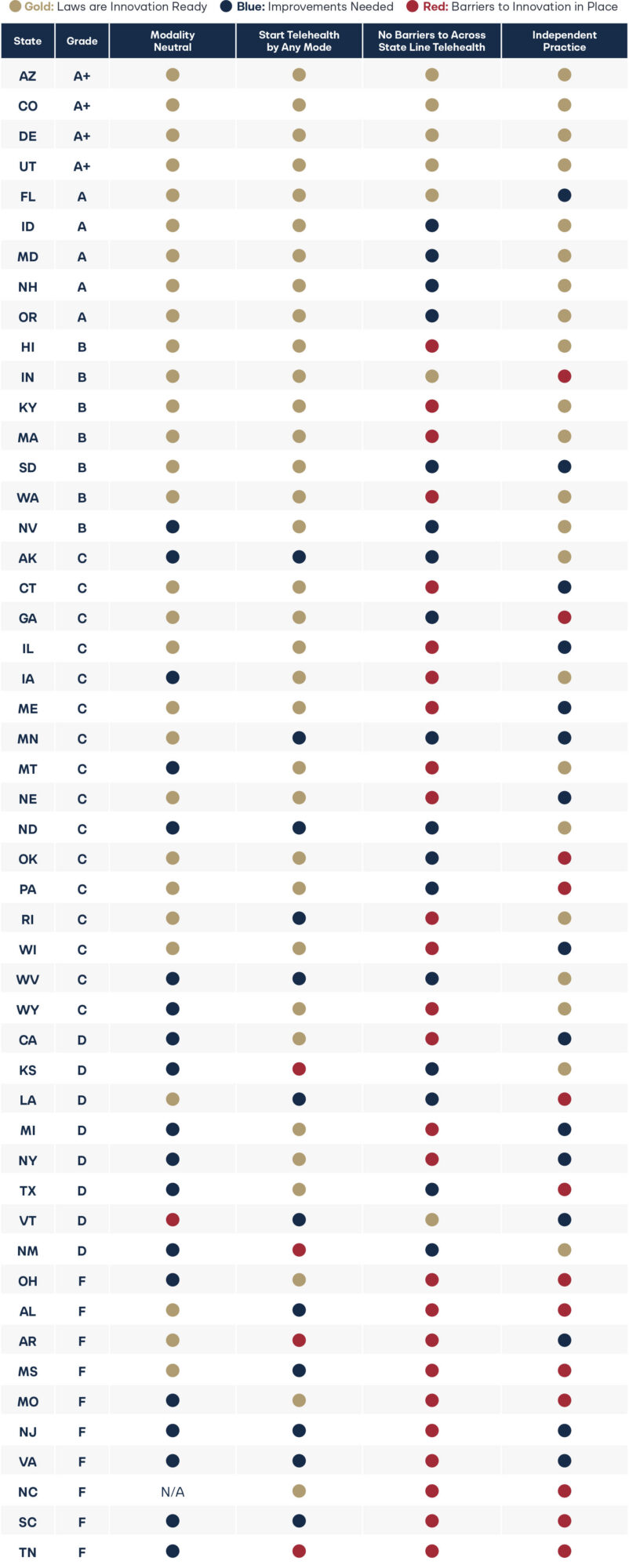
Methodology for Grades
This report focuses on four key telehealth policy areas: modality-neutral policies, starting a telehealth relationship by any mode, no barriers to across-state-line telehealth, and independent practice for nurse practitioners (all of which are covered in greater depth in the appendix) that impact a patient’s ability to access care. This report examines state telehealth policies for fully-insured private insurance plans and laws that impact provider practice in each state. It does not consider Medicaid policies on telehealth.
To assign the letter grades, we used the following method:
For each of the four policy areas, states earned the maximum number of points if their state laws met our gold standard, received half credit if they were in partial compliance (our blue ranking), or zero credit if they were in non-compliance either actively or by omission in their state laws (red ranking).
We gave them all equal value as they are often interconnected for patients. Being able to use live video telehealth is important for some patients, but just as important for ongoing care may be the ability to use remote patient monitoring for a patient being cared for at home, for example. With more and more AI-aided tools hitting the market, being able to start that telehealth relationship and use the best technology available to start a relationship matters. As provider shortages grow, having a more flexible health system will require a health workforce ready to fully leverage technology to meet the health needs of our country. Access to telehealth for patients to all provider types (including nurse practitioners’ independent practices) across state lines is a proxy for a state’s willingness to engage in that discussion.
Appendix 1: Policy Areas Covered in This Report
Modality Neutral
A quality-oriented, provider and patient-centered health system means allowing for many kinds of telehealth, not just live video. For this category, the report largely follows the term as defined by the American Telemedicine Association (ATA) which points to a “modality-neutral” definition of telehealth including various methods whether asynchronous or synchronous, and various technologies whether by audio-video, store-and-forward, or remote patient monitoring.
“Telehealth” means a mode of delivering healthcare services using telecommunication technologies, including but not limited to asynchronous and synchronous technology, and remote patient monitoring technology by a healthcare practitioner to a patient or a practitioner at a different physical location than the healthcare practitioner.
Remote patient monitoring refers to the transmission and monitoring of personal health data (including vital signs, weight, blood pressure, blood sugar, blood oxygen levels, heart rate, and electrocardiograms) via electronic communication technologies. Remote patient monitoring allows providers to track a patient’s health data outside of a facility. This is beneficial for preventing readmissions and allowing older adults and individuals with disabilities to live at home and avoid admission into a skilled nursing facility.
Store-and-forward refers to the electronic transmission of digital medical information including prerecorded video or images (such as X-rays, MRIs, or photos of skin conditions). Store-and-forward transfers are particularly useful for consultations with specialists who can review medical information after it has been collected and uploaded. This provides patients access to specialty care promptly without the need for coordinating schedules and lengthy travel.
Start Telehealth by Any Mode
Every patient has their own preference for how to interact with a healthcare provider. As a result, allowing flexibility for the relationship to be initiated through the patient’s preferred modality—when the standard of care can be met—is imperative. Imagine someone experiencing a behavioral health crisis in the middle of the night. They might strongly prefer to start communication by text or in an asynchronous manner before being comfortable switching to a video call or in-person visit. Providers should be able to accommodate that preference so long as the standard of care can be met. If the nation’s healthcare system is going to be more patient-centered and accessible while taking care to avoid wasting money, state laws need to ensure these methods to deliver care are available. Some states allow for the use of both synchronous and asynchronous modalities but may limit the modalities that a provider may use to form the relationship—regardless of what is clinically appropriate. That is what is being ranked here. Laws and board regulations should remove barriers that get in the way of forming a telehealth relationship.
No Barriers for Patients to Across-State-Line Telehealth
Allowing patients to access providers outside their community is imperative as most cities and towns simply lack certain kinds of providers. Telehealth may be their only option for seeing a specialist, getting a second opinion, or accessing team-based care. Allowing across-state-line telehealth ends geographic and economic discrimination for many patients and allows access to providers who would not otherwise be accessible due to distance or the expense of travel.
Too many states and medical boards have made it time-consuming and expensive to see patients outside their home state. Others have prohibited it entirely. Pilots don’t lose their skills when they cross a state line, and neither do healthcare professionals. As Americans become increasingly mobile, being able to stay in touch with providers who know the patient’s history and have their trust is imperative to better health outcomes.
This category highlights states that allow providers in good standing to see patients in another state without jumping through expensive time-consuming hoops—and not just for a consultation with another provider or during an emergency. States that earned a positive ranking often allowed providers to register to see new patients or provide simple reciprocity for providers in good standing. Anything over and above these requirements are barriers to the provider-patient relationship, and many of the provider compacts being pushed have severe, unnecessary limitations.
Imagine that a family member gets sick and the nation’s leading expert on treating the illness works at the Cleveland Clinic in Ohio, where you don’t live. If you are wealthy, you could travel to Ohio and pay out of pocket for the services. If you are middle-class or low-income, you have no such option. Your family member could not see this specialist unless they convinced the provider to go through the time and expense of obtaining a full medical license in their state. This is discrimination by geography and economic status. Telehealth reform is a market-based equalizer.
Previous research from the Cicero Institute has shown few disciplinary problems for across-state-line telehealth, making it a safe and smart solution.12
Independent Practice
The report rates each state based on whether nurse practitioners (NPs) are allowed to practice as they have been trained, or if the state still requires a doctor to provide oversight or co-sign their work.
The U.S. has an acute shortage of doctors that is projected to grow in the years to come. Expanding the supply of healthcare professionals with high-quality nurse practitioners is not only a prudent option, it is a necessity. It increases practitioner access for patients while allowing doctors to focus on the most complex cases and sickest patients. Ample research has shown that expanding NPs’ scope of practice increases access to care and reduces costs without compromising quality. Absent reform, many patients may be forced to go without care.
It is important to acknowledge that expanding the scope of practice for pharmacists, physician assistants, dentists, and other medical providers can also be important as well. However, because of the impact of NPs being allowed to practice independently on patient access, this was the focus of the report.
Appendix 2: State Innovation Policies Updates Needed
| State | Modality Neutral | Start Telehealth by Any Mode | No Barriers to Across-State-Line Telehealth | Independent Practice |
|---|---|---|---|---|
| AL | Add robust definitions for telehealth. | Make it clear that a patient-provider relationship can start over any mode. | Replace limited special purpose licenses for just doctors and replace it with an easy registration or reciprocity law for all providers. | Allow NPs to practice independently. |
| AK | Add a definition for remote patient monitoring or store-and-forward technologies. | Remove standard that it is considered unprofessional conduct if providing treatment, rendering a diagnosis, or prescribing medications based solely on a patient-supplied history that a physician licensed in this state received by telephone, facsimile, or electronic format. This puts in place a barrier to patients starting a relationship in the mode they prefer. | Amend or replace the Alaska business license requirement for telehealth providers to allow for an easy registration or reciprocity law for all providers. Alternatively, allow all providers on a multi-disciplinary team to see patients independently as passed in SB 91. | N/A |
| AR | N/A | Update Medical Board regulations that require a face-to-face examination using real-time technology, and forwarded medical histories to establish a patient-provider relationship. These rules limit patient choice to start a relationship in an asynchronous manner. | Pass an easy registration or reciprocity law for all providers. | Remove the collaborative practice agreement mandate of 6,240 hours before NPs can practice independently. |
| AZ | N/A | Amend Medical Practice Act to remove restrictions on prescribing by providers to only those with an established doctor-patient relationship or those who conduct an examination during a real-time telemedicine encounter with audio and video capability. This places a barrier to patient access to the provider that is the best fit for their care. | N/A | N/A |
| CA | Add a definition for remote patient monitoring. | Make it clear that a patient-provider relationship can start over any mode. | Pass an easy registration or reciprocity law for all providers. | Remove 4,600-hour supervision mandate. |
| CO | N/A | N/A | N/A | It would not impact the ranking, but an additional suggestion is to eliminate the mandated transition period for prescription authority. |
| CT | N/A | N/A | Eliminate requirement that providers must engage with or contract with an in-state provider or entity before seeing a patient in the state. Remove the Commissioner of Public Health approval step of each application, making it automatic if the provider meets certain criteria. | Remove three-year supervision mandate. |
| DE | N/A | Amend the Medical Practice Act to remove real-time modality. | N/A | N/A |
| FL | N/A | N/A | Should remove prohibition on registered telehealth providers from providing in-state care. | Remove 3,000-hour supervision mandate. |
| GA | N/A | Make it clear that a patient-provider relationship can start over any mode. | Expand special telemedicine licenses for physicians to all providers from other states in good standing. | Allow NPs to practice independently. |
| HI | N/A | N/A | Pass an easy registration or reciprocity law for all providers. | N/A |
| IA | Add definition for remote patient monitoring and store-and-forward into state law, remove interactive requirement. | Make it clear that a patient-provider relationship can start over any mode. | Pass an easy registration or reciprocity law for all providers. | N/A |
| ID | N/A | N/A | Expand the across-state-line option opened for behavioral health to all provider types. | N/A |
| IL | N/A | Remove established patient requirement that blocks some patient access to starting a relationship. | Pass an easy registration or reciprocity law for all providers. | Allow NPs to practice independently by removing the transitional collaborative practice agreement mandate of 4,000 hours and 250 hours of continuing education. |
| IN | N/A | N/A | N/A | Allow NPs to practice independently. |
| KS | Remove real-time requirement in the definition of telemedicine, and add definition for remote patient monitoring. | Make it clear that a patient-provider relationship can start over any mode. | Expand telemedicine waiver in law that currently only applies to the 16 professions regulated by the Kansas State Board of Health Arts to apply to all providers. This may require a broadening of the definition of healthcare provider in the statute. | N/A |
| KY | Add a definition for store-and-forward. | Make it clear that a patient-provider relationship can start over any mode. | Pass an easy registration or reciprocity law for all providers. | Remove four-year practice requirement before being allowed to prescribe. |
| LA | N/A | Make it clear that a patient-provider relationship can start over any mode which will lead to changes to the Board of Medical Examiners regulations that raise doubt that a patient can start a relationship by asynchronous telemedicine. | Make it clear that referrals to in-state providers are not mandated, but should follow the normal standard of care if necessary. Additionally, amend new regulations (Ch 2, 401.1.C) for behavior analysts to remove the de facto requirement of an in-state license for telehealth. | Allow NPs to practice independently. |
| MA | N/A | N/A | Pass an easy registration or reciprocity law for all providers. | Remove two years of experience before allowed to prescribe. |
| MD | Remove the interactive requirement in the insurance code. | N/A | Pass an easy registration or reciprocity law for all providers that extends beyond just the narrow list currently allowed for physicians. | N/A |
| ME | N/A | Make it clear that a patient-provider relationship can start over any mode. | Remove physician consultation limitation for across-state-line care, and pass an easy registration or reciprocity law for all providers. | Remove 24-month supervision mandate. |
| MI | Add definition for remote patient monitoring. It exists for Medicaid in the state but not the private market. | N/A | Pass an easy registration or reciprocity law for all providers. | Allow NPs to practice independently without a delegation requirement for certain kinds of prescribing and for Medicaid reimbursement. |
| MN | Update current law that defines telehealth as having to be a real-time, two-way interactive audio and visual communication, but also allows store-and-forward options. This can cause confusion. | Make it clear that a patient-provider relationship can start over any mode. | Expand the physician across-state-line registration or a reciprocity law to all providers. | Remove 2,080-hour collaborative practice agreement mandate. |
| MO | Add definition for remote patient monitoring. | N/A | Pass an easy registration or reciprocity law for all providers that extends beyond the narrow list currently allowed for physicians. | N/A |
| MS | The state definition includes store-and-forward and remote patient monitoring, but mandates everything else be real-time audio video, unless the Commissioner of Insurance allows other situations without that. Update the definition to remove any real-time requirement. Remove the sunset in 2028. | Fixing the definition list in column one would make it clear that any mode is accepted to start a provider-patient relationship. Board of Medical Licensure regulations need to be fixed to remove requirements of telehealth being capable of replicating an in-person visit, as that prevents a patient-provider relationship from being established through asynchronous telehealth. | Pass an easy registration or reciprocity law for all providers. | Allow NPs to practice independently. |
| MT | Add definition for remote patient monitoring. | N/A | Pass an easy registration or reciprocity law for all providers. | N/A |
| NC | Add robust definitions for telehealth. A law this year added the definition that appears only to apply for mental health, and was tied to disaster assistance and recovery. Building out these definitions to more standard language would bring clarity. | Make it clear that a patient-provider relationship can start over any mode. | Pass an easy registration or reciprocity law for all providers. | Remove collaborative agreement mandate. |
| ND | Add a definition for telehealth that mentions remote patient monitoring. | Make it clear that a patient-provider relationship can start over any mode. Remove in-person medical evaluation in the North Dakota Food, Drug and Cosmetic Act. | Expand on license by endorsement that only applies to physicians and physician assistants to apply a reciprocity or easy registration to all providers in good standing. | N/A |
| NE | N/A | N/A | Pass an easy registration or reciprocity law for all providers. | Remove 2,000-hour supervision mandate. |
| NH | N/A | N/A | Build on the reciprocity law for physicians and physician assistants to include all providers and put in place an easy registration process for telehealth services. Or expand tele-pass for psychologists to all providers. | N/A |
| NJ | Remove any remaining references in regulation for real-time or video-only telehealth. | Make it clear that a patient-provider relationship can start over any mode. | Pass an easy registration or reciprocity law for all providers. | End collaborative agreement mandate for prescribing. |
| NM | Remove interactive requirement. | Update regulations that require face-to-face telehealth visits. And allow prescribing without face-to-face encounters. | Streamline special telemedicine license for doctors, and pass an easy registration or reciprocity law for all providers. | N/A |
| NV | Add definition for remote patient monitoring. | N/A | Streamline Board of Medical Examiners optional special purpose licenses to a registration. Pass an easy registration or reciprocity law for all providers. | Remove two years or 2,000-hour requirement before being able to prescribe controlled substances. |
| NY | Add definition for remote patient monitoring or store-and-forward telehealth. | Make it clear that a patient-provider relationship can start over any mode. | Pass an easy registration or reciprocity law for all providers. | Remove collaboration mandate. Remove collaboration mandate, and 3,600 hours of practice requirement before allowing independent practice. |
| OH | Add a definition for telehealth that mentions store-and-forward, and remote patient monitoring. | N/A | Pass an easy registration or reciprocity law for all providers. | Remove collaborative agreement mandate and let NPs practice independently. |
| OK | N/A | N/A | Pass an easy registration or reciprocity law for all providers that moves beyond the subjective process only extended by the Board of Osteopathic Examiners. | Remove supervision mandate and collaborative agreement mandate. |
| OR | N/A | It would not impact the ranking, but it would be helpful to make it clear that a provider-patient relationship can be started by an online form when appropriate. | Pass an easy registration or reciprocity law for all providers that moves beyond the subjective process only extended to physicians (MD/DO), podiatric physicians, and physician assistants. | N/A |
| PA | Add a definition for store-and-forward. | N/A | Pass an easy registration or reciprocity law for all providers that extends beyond just the providers from adjoining states. | Remove collaborative agreement mandate and let NPs practice independently. |
| RI | Remove reference in regulation (216-RICR-40-05-1) that states that asynchronous evaluation of a patient, without contemporaneous real-time, interactive exchange between the physician and patient, is not appropriate. | Make it clear that a patient-provider relationship can start over any mode. | Pass an easy registration or reciprocity law for all providers. | N/A |
| SC | Add definitions for remote patient monitoring and store-and-forward in the provider code. | Make it clear that a patient-provider relationship can start over any mode. | Pass an easy registration or reciprocity law for all providers. Don’t require providers living out of the state still to obtain a South Carolina full license. | Remove the written protocol requirement. |
| SD | N/A | N/A | Pass an easy registration or reciprocity law for all providers, and make the physician pathway automatic if they are in good standing. | Remove 1,040-hour practice mandate before being allowed to practice independently. |
| TN | Remove prohibition of remote patient monitoring for provider-based telemedicine.; Add definition of remote patient monitoring. | Remove requirement that for provider-based telemedicine there has to be proof of an in-person encounter and an insurance claim. TN and WV are the only states with this out-of-date requirement.; Remove requirement that for a patient to receive telehealth they must be at a qualified site such as a school, and that providers must have access to the patient’s medical record. | ||
| TX | Add definitions for remote patient monitoring and store-and-forward. | N/A | Streamline across-state-line pathway for physicians to just a registration or none. Add universal pathway for all other providers in good standing. | Allow NPs to practice independently. |
| UT | N/A | Allow the provider-patient relationship to be formed using online options, including for prescriptions. | N/A | N/A |
| VA | Add formal definitions outside of the statewide telehealth plan for remote patient monitoring and store-and-forward. | Make it clear that a patient-provider relationship can start over any mode. | Pass an easy registration or reciprocity law for all providers. | Remove five-year practice requirement before allowing independent practice. |
| VT | Remove the live requirement for telemedicine. Add definition for remote patient monitoring. Remove requirement for an image for store-and-forward communication. | Make it clear that a patient-provider relationship can start over any mode. | State should expand the across-state-line license and registration to all provider types, and remove the patient limit and prohibition of care in the state. | Remove the 2,400-hour or two-year collaborative agreement mandate. |
| WA | N/A | N/A | Pass an easy registration or reciprocity law for all providers. Expand the pathway passed in SB 5481. | N/A |
| WI | N/A | N/A | Pass an easy registration or reciprocity law for all providers. | Allow NPs to practice independently by removing the transitional supervised practice agreement mandate of 3,840 hours and the 24-month minimum since the start of practice. |
| WV | Add definition for store-and-forward. Remove established patient category to remove face-to-face requirement. | Remove interactive and real-time requirements to establish a patient-provider relationship. | Remove prohibition from seeing a patient in state, and allow patients to see across-state-line physicians from other states without requiring them to first be licensed in West Virginia. | Remove three-year collaborative agreement mandate for prescribing. |
| WY | Add a uniform definition for telehealth that makes it clear that synchronous, asynchronous, remote patient monitoring and store-and-forward are allowed. | N/A | Pass an easy registration or reciprocity law for all providers. | N/A |

Stay Informed
Sign up to receive updates about our fight for policies at the state level that restore liberty through transparency and accountability in American governance.