
Texas Leaders Should Reject Woke Personal Finance in Schools

The Texas State Board of Education will soon be faced with a curriculum question that affects students far beyond the classroom. NextGen Personal Finance (NGPF), a California nonprofit with nearly $40 million in assets, is attempting to sway Texan officials into adopting their financial literacy curriculum. NGPF presents itself as simply informing highschoolers about the basics of taxes, loans, and the like. But in reality, NGPF’s curriculum is a vessel for socialist propaganda and woke ideology that rejects the American notion of equality.
Under House Bill 27, passed in 2025 by the Texas Legislature, all Texas public high school students must take a personal financial literacy course to graduate. NGPF, which lobbied successfully for this new requirement, now stands ready to provide a prebuilt curriculum to every public high school in Texas. Alongside evenhanded discussion of topics like interest rates, NGPF’s curriculum smuggles in content with a clear ideological bias.
In NGPF’s unit titled “Racial Discrimination in Finance,” for instance, students are asked to compare various financial data across races and given background on how the American system has supposedly caused the unfair disparity.
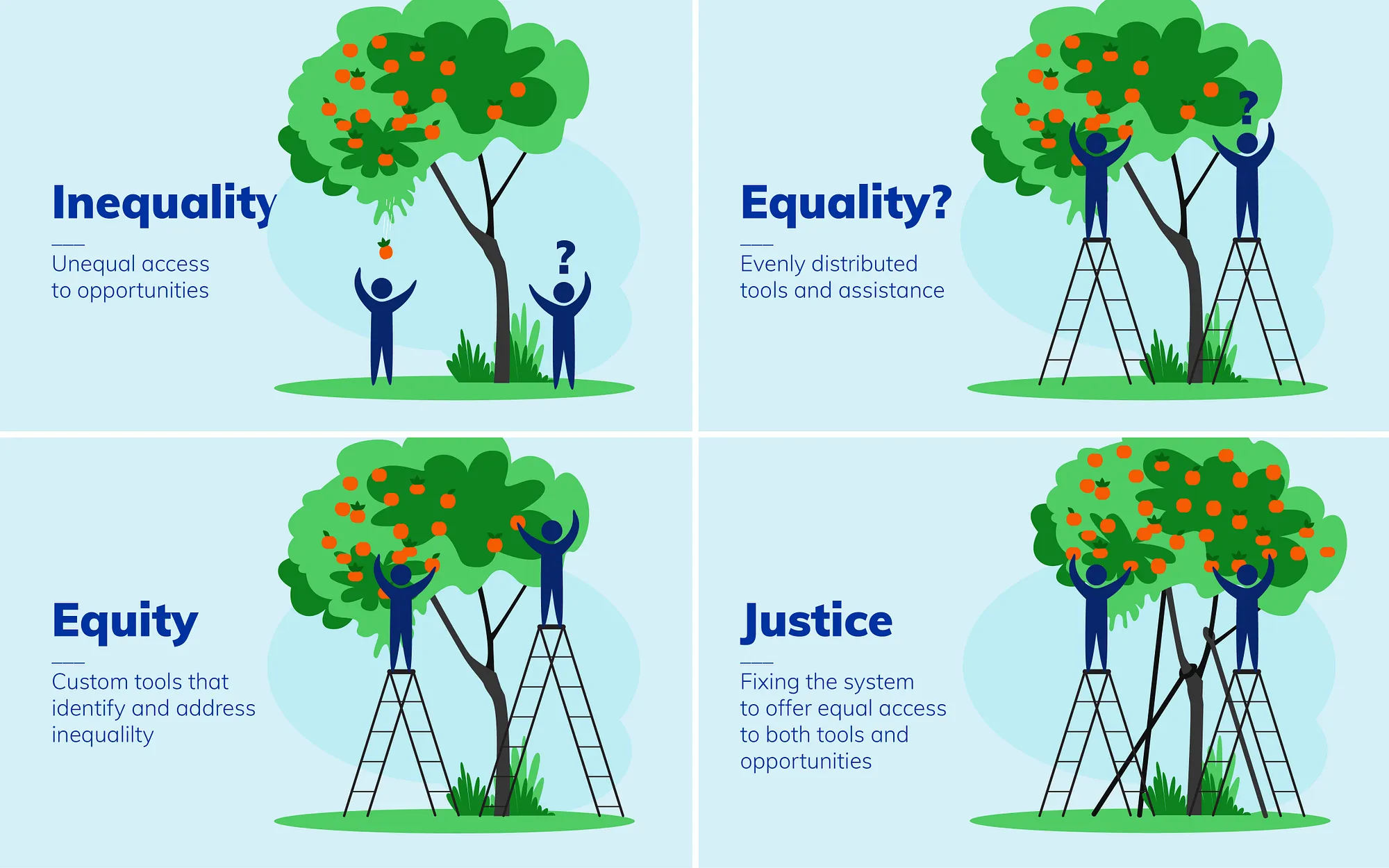
Separately, in a student activity packet , NGPF portrays America’s free market system as an “equality” system and deems it unfair (see Figure 1). The graphic shows two men reaching for fruit on a tree. One man is able to grab the fruit, and the other cannot reach it as it does not grow in the spot he is reaching towards. Neither “equality” nor “equity” are fair according to this graphic; only the system of “justice” which artificially produces the same outcomes for both people is “fair” according to NGPF. The reality is that in the free market, the man who is not turning a profit can just set up his ladder on the other side, build a taller ladder, or go to another tree. By dismissing this notion of personal responsibility, NGPF also distorts the meanings of fairness, equality, and justice.
Figure 1: Graphic from NGPF student activity packet
Ideology aside, NGPF’s course is strikingly unchallenging. It does not ask students to engage in serious study or hone writing or analytical skills. In their “Behavioral Economics” unit, NGPF muses about social scenarios and “your brain” as it relates to concepts like FOMO, to the detriment of more relevant content like the way markets work. Under the guise of financial education, this curriculum spoon feeds woke ideology to highschoolers (implicitly in some instances, and explicitly in others), while leaving absent the most fundamental principles of America’s economic system.
NGPF repeatedly champions the notion that people must be made equal through government action––a foundational premise of both socialism and woke ideology. Students taking this curriculum are explicitly asked to find a relationship between justice and reparations. In fact, NGPF utilizes an entire section to promote reparations through biased history lessons that assert that reparations are merely “one step on the path toward racial justice.”
In doing so, they reject the American understanding of equality as found in the Declaration, as explained by writer, speaker, and former slave, Frederick Douglass. Douglass argued that beyond the vote, nothing else should be given to black men, for the very idea of the black man needing to be “set up” by the white man is the same lie that slavery itself is built upon: fundamental inequality between the races. Slavery and 21st century reparations theory both assume that black men can’t make it in a free market, and so must be put in a unique position in order to succeed.
The DEI movement and woke ideology championed by NGPF result directly from a broader war on the foundational principles of American civilization and can therefore be rectified by deeper study of those principles. The modern educational push toward “useful study” utilizes foundational terms such as justice and equality but asserts perverse definitions rather than promoting serious inquiry into them.
NGPF likely knows they will receive some backlash for providing a curriculum that neglects to cover the foundations of markets or basic economic theory, and which seems certain to stifle conversation among students about complex questions of reason, equality, justice, moral character, and more. In response to this objection, as found in their “Advocacy Toolkit,” NGPF doubles down on their ideology, responding that rigorous economic study is obsolete because we supposedly don’t use it in our day-to-day lives.
What NGPF fails to note is that economics teaches students why our society operates the way it does, connecting a robust notion of human nature to value, labor, and a political community. In this way economics is useful; everyone can and should learn the “facts” of financial literacy but knowing how to operate in the system is worthless without understanding why it works the way it does. By divorcing “practical tips” from its related fundamental study, groups like NGPF are able to distort concepts like justice, equality, and the human person, thus promoting a rejection of the free market in favor of socialism. If a student is given a holistic education that provides ample opportunity for critical thinking with an emphasis on the pursuit of virtue, students will develop strong moral codes that will allow them to act appropriately against injustice they see in their community. Instead, NGPF offers a socialist, reparations-based theory for the system, and social media advocacy (yes, this is a real student project listed on their website) as substitutes for strong character. Groups like this do not believe in the ability of the human person to regulate themselves and act uprightly, because they do not believe that in reality, all men share an equal nature, the cornerstone of the American project. So they condemn America for “racism and unfairness” and push views that undermine the principles our nation was built on. They degrade what equality means by treating it as simply a matter of the physical possessions that one has. They would not feel the need to make everyone equal in material possession if they believed that we were equal already in nature.

Stay Informed
Sign up to receive updates about our fight for policies at the state level that restore liberty through transparency and accountability in American governance.