
Electronic Monitoring of Homeless Sex Offenders


Introduction
In every jurisdiction across the United States, sex offenders hold a special status that subjects them to more expansive supervision and restrictions than other types of convicted criminals, and courts have long held that most of these restrictions do not improperly encroach on their civil liberties.1 The longest employed and most widespread is the requirement to comply with sex offender registry laws in the state of residence. Rules vary, but, at a minimum, include the requirement to regularly report current names and addresses to law enforcement.2
However, those charged with ensuring public safety face a significant challenge in tracking one particular subgroup of convicted sex offenders: those who are homeless or transient and therefore cannot report a fixed address.
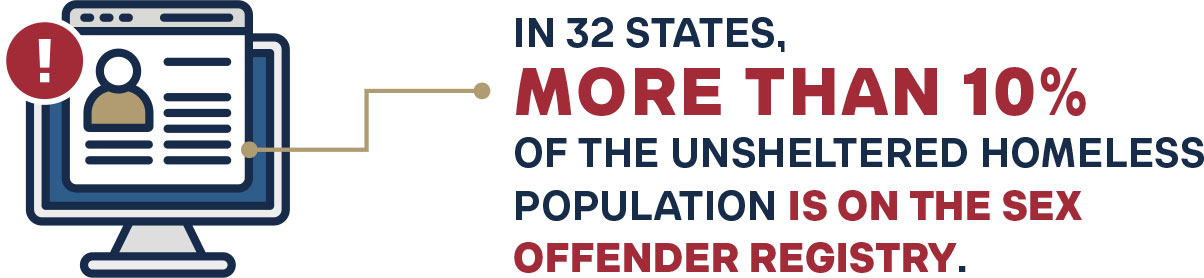
While the vast majority of sex offenders are not homeless, those who are make up a sizable portion of the general homeless population.3 A recent report from the Cicero Institute that studied homeless sex offender populations in 41 states attests to the significance of this problem.4 The findings show that in 32 states, more than 10 percent of the unsheltered homeless population is on the sex offender registry. In eight states, that number shockingly exceeds 50 percent.5 This raises serious questions about public safety as it relates to homelessness and sex crime.
Approximately half of sex offenders released from prison recidivate within five years.6 Notably, they are known to commit additional sex crimes at between two and six times the rate of other types of criminals after prison.7 These figures likely understate the true re-offense rate, as sexual assaults are among the most underreported crimes. Homelessness further compounds this risk, as it is associated with higher rates of reoffending for both offenders in general and sex offenders in particular.8–9
The prevalence of sex offenders in the unsheltered homeless population exposes the challenges of carrying out interventions that may be most appropriate and effective in addressing supervision and management strategies in transient sex offender populations. The current inconsistent standards must be brought into uniformity to ensure the usefulness of the registry to law enforcement in protecting the public.
Electronic monitoring of transient sex offenders holds significant potential as a remedy for the current limitations of the address-based registry and offers a practical means of achieving commensurate supervision of this subpopulation while providing substantial public safety benefits.
Sex Offenders in the U.S.
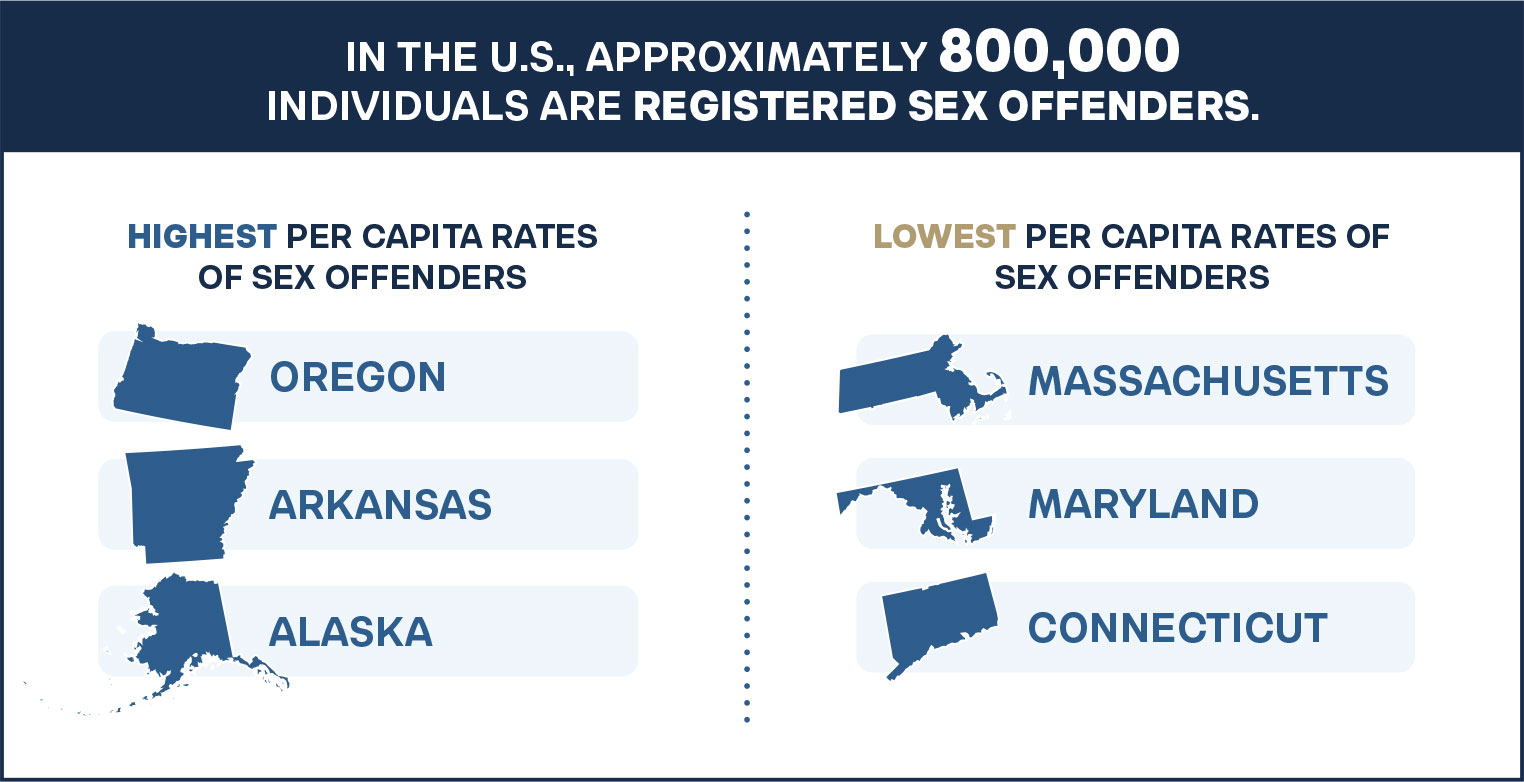
Approximately 800,000 individuals are registered sex offenders in the United States.10 Sex offender registries are managed at the state level, creating considerable variation in who is classified as a sex offender in each state and the relative size of the sex offender population. For example, Oregon, Arkansas, and Alaska have the highest per capita rates of sex offenders, while Texas and California have the highest total numbers, exceeding 70,000 and 60,000, respectively.11 Massachusetts, Maryland, and Connecticut have the fewest sex offenders per capita.12
Harris, Levenson, and Ackerman (2014) found that between two and five percent of the nation’s registered sex offenders are homeless, compared with less than a third of a percent of the general population.13 The high rate of homelessness among sex offenders was reaffirmed by state-specific studies such as those of South Carolina (Cann and Scott 2020) and Delaware (Metraux and Modeas 2023).14–15
History of the Sex Offender Registry
The first state to require sex offenders to register with law enforcement was California, which did so in 1947.16 The original intention of sex offender registries was to provide investigators with a ready-made list of possible suspects in the vicinity of a crime. However, their usefulness to the criminal justice system grew to include providing prosecutors with additional leverage in negotiating plea deals and allowing law enforcement to use charges for an offender’s failure to register or other violations as a stand-in for crimes they could not prove.17 By 1996, all states had created some form of sex offender registry.18 The U.S. Congress’s passage of the Adam Walsh Act in 2005 established a national registry to which all states were required to contribute, including offenses dating back to the 1970s.19 The Adam Walsh Act also required states to instruct law enforcement to inform the public when sex offenders were being released from prison through so-called “community notification” policies, though not every state is in full compliance with that law.20
Community notification policies vary in content far more than registration policies, which are similar in purpose, though distinct in structure and governance, across states. Despite federal requirements of the Adam Walsh Act, fewer than half of the states have some form of community notification policy, and those that do differ considerably in the scope and implementation of their policies. On one end is California, which leaves notification policies up to local law enforcement agencies; on the other is Alabama, which requires law enforcement to distribute leaflets with identifying information about the released sex offender to everyone living within 1,000 feet of the offender’s residential address.21 Lasher and McGrath (2012) systematically reviewed the literature on policies related to sex offender community notification and their potential impact on employment and housing opportunities.22 A significant number of studies found an impact, though only the more active forms of community notification, such as those in Alabama, were associated with social destabilization related to employment or housing.23
How Sex Offender Registries Fall Short in Transient Populations
Sex offender registries and community notification policies both rely, to some degree, on the residential addresses of sex offenders to provide useful information to law enforcement and the public. These address-based management strategies offer law enforcement very little useful information about sex offenders who cannot provide an address.
Homeless sex offenders may be required to report to law enforcement in person on a more regular basis than sex offenders with an address, but this too provides little useful information to law enforcement. Furthermore, 2024 legislative testimony offered in Maryland attests to the difficulties and usefulness of the registry in homeless populations and notes that compliance with registry requirements sits at less than 60 percent.24
Unlike sex offenders with an address, law enforcement does not receive particularly helpful information they can use to locate a sex offender should a situation arise, nor are they provided with information to verify the accuracy sex offender’s attested homeless status. The comparatively relaxed supervision standards for transient sex offenders create an implicit incentive for sex offenders to identify as homeless, even if they are not. The extent to which sex offenders misleadingly identify as homeless needs to be investigated.

Effectiveness of Electronic Monitoring
Research on electronic monitoring (EM) suggests that these supervision tools hold a great deal of potential to improve public safety, though they pose several distinct challenges compared to other forms of supervision.
The UK College of Policing (2017) performed a meta-analysis on EM studies from 2000-2015, finding that electronic monitoring was effective at reducing recidivism among sex offenders when compared with either traditional supervision or the alternative of prison.25
In 2012, the California Supervision Program published a robust study on the impact of EM as a supplemental tool to traditional supervision for high-risk sex offenders. Electronic monitoring in the form of Global Positioning System (GPS) tracking resulted in an arrest rate of just 14 percent for any offense, compared with 26 percent for those under only traditional supervision. When considering new violations, arrests, convictions, and returns to custody, the treatment group (high-risk sex offenders receiving electronic monitoring in addition to traditional supervision) demonstrated lower recidivism than the control group, with statistical significance. Furthermore, receiving EM was significantly positively associated with therapy attendance, which itself is associated with lower recidivism.26
Older studies paint a more complex picture, although often with weaker methodology and inferior technology. The Tennessee Board of Probation and Parole (2007) failed to assert with statistical significance a difference in recidivism rates between sex offenders receiving EM as opposed to exclusively traditional supervision. Even so, GPS officers overwhelmingly reported EM to be a useful tool and identified numerous areas for future implementation improvement. The study authors also acknowledged substantial differences in the composition of the treatment and control groups.27
More recent research has found electronic monitoring to be strongly associated with a decrease in re-offense rates for both violent and non-violent offenses among general offender populations.28
Studies of electronic monitoring raise several other key concerns:
Risk of Retaliation
While anecdotal reports raise alarm about the risk of vigilante violence and adverse psychological impacts for sex offenders receiving EM, the scientific evidence for these concerns is weaker. For instance, the Tennessee Board of Probation and Parole (2007) flagged parolee comments about EM attracting hostile attention or lowering parolee morale for previously compliant offenders.29 By contrast, Hawkes, Sellbom, and Gilmour (2023) investigated claims that GPS tracking is associated with negative mood among male offenders, who account for roughly ninety percent of the offender population. This study found no association between the use of EM and parolee mood, although it should be noted that this study investigated male offenders in general, not male sex offenders in particular.30
Movement Restriction
Electronic monitoring can also utilize inclusion and exclusion zones to enforce restrictions on where sex offenders can live or spend time. These zones provide timely notifications that can confirm presence at a treatment facility or alert officers if offenders approach a prior victim’s home or other areas of restricted travel. Despite this value, in the California study of high-risk sex offenders, Gies et al. (2012) find that just 60 percent of agents always or frequently discussed inclusion zone restrictions during their process evaluation, and only half of the agents discussed exclusion zones.31
Privacy
Critics of EM argue that this form of supervision presents a dangerous intrusion into the lives of former offenders living in the community. This concern is typically alleviated when EM is used as an alternative to heightened infringements on liberty, such as jail or prison. But when considering EM for former offenders who are not on probation or parole, the discussion of privacy and liberty is much more nuanced.
In the case of sex offenders, transience is an important context that must inform discussions on privacy. Registered sex offenders must provide an address that can be monitored by both law enforcement and the public. Transient sex offenders do not have a permanent address and therefore are exempt from providing one. The result is a population of high-risk offenders who are monitored to a lesser degree than their peers, calling into question the equal application of the law. Electronic monitoring can equalize this miscarriage of justice. It is the most practical response, as it is the best form of supervision that can provide data on an individual’s location of residence while they do not live in a fixed location.
The question of whether EM is a commensurate form of supervision to the registration of permanent addresses is also relevant. Here, EM in its most common form seems to go far beyond the intrusions of privacy for sex offenders who are not homeless. Some jurisdictions do permit EM of all sex offenders regardless of homelessness status, but the expense of doing so practically limits use of this technology to transient sex offenders or high-risk offenders classified as “sexually violent predators” (SVP) in most cases.32
But for jurisdictions that do seek to limit EM to only sex offenders who do not reside at a permanent address, there are ways to keep the levels of supervision in approximate proportion. One would be to limit EM check-ins to set intervals and emergencies, such as two or three times per day, especially at hours when an individual would likely be sleeping, to approximate a location of residence. Law enforcement could have discretion to also ping the monitors during a relevant emergency where the location of sex offenders is of heightened interest to protect the public.
Fiscal Impact
Electronic monitoring adds only a fraction of the cost of traditional supervision, and technological innovations have further reduced its relative cost.33 Modern artificial intelligence offers significant untapped potential to reduce the labor costs associated with technical alerts. Lastly, EM can have a net positive fiscal impact when the reduced costs of crime associated with it outweigh the added costs of heightened supervision.
Other Insights
Research has offered a number of potential ways to improve EM from its current state. The use of a centralized monitoring center in each state to screen alerts could help reduce trivial notifications such low battery warnings.34 Because EM is supplemental supervision, it can potentially impose a significantly higher burden for the same caseload, disrupt other tasks with alerts, and excessively interfere with officers’ personal lives due to the number of alerts that come with 24/7 monitoring and data input requirements.35 Gies et al. (2012) also indicated challenges such as reductions in the amount of time officers could spend in the field engaging with people under supervision.36 Initially implementing smaller caseloads as officers acclimate, and utilizing more staff support resources that are specialized in managing EM can significantly reduce data entry and evaluation tasks.37 This provides the benefit of officers being able to focus on high-intensity cases, as EM compliance is very high. Another possible solution is the potential application of AI to assist in screening the many alerts generated by EM systems, reducing the workload for staff and accelerating response times.
Proposal: Electronic Monitoring
The current system of monitoring sex offenders creates an unjust and unsafe double standard that allows sex offenders to avoid reporting an address and receiving comparable standards of supervision. Requiring the EM for sex offenders who lack a permanent address, or even a smaller subset of high-risk transient sex offenders such as those designated as “sexually violent predators,” would address this weakness of the current residence-based registry. It also offers law enforcement more tools to address the rampant crime associated with homeless encampments, where individuals, especially children, experience high rates of sexual violence that often go unreported.38–39
Annual reports on key success metrics, along with any implementation challenges, should be provided to the appropriate state legislative committees and state agencies. Finally, policymakers should carefully consider the increased workload per case that parole officers manage through electronic monitoring to mitigate officer burnout and prevent increased recidivism.
Electronic monitoring can take many forms, and these different approaches offer unique advantages that policymakers can consider when determining the optimal implementation strategy.
In terms of technology, GPS trackers and mobile apps are two different options that can be applied to parolees. Most studies have focused on GPS tracking devices, such as ankle monitors, which have demonstrated a high capacity to reduce recidivism in a cost-effective manner. Mobile apps may augment or substitute for these traditional devices, reducing the visibility of an offender’s status to members of the public while still providing for a variety of tracking options.
There are also various options for how frequently law enforcement receives information from electronic monitors, allowing for proportional considerations of risk and privacy.
- Continuous, real-time location data to a central monitoring system
This option provides law enforcement with the most data, which can
create greater workloads but also greater insights useful to public safety.
It is the most intrusive in terms of offender privacy. - Limit location data to zone restrictions
Law enforcement would be informed only when an offender leaves an
inclusion zone or enters an exclusion zone. - Intermittent location reporting
Law enforcement would receive data a few times a day at hours comparable
to those when an individual is most likely to be at a permanent residence.
Each of these options has distinct trade-offs in terms of public safety, workload, and privacy. The balance and prioritization of these concerns should reflect the needs and attitudes of the communities using electronic monitoring. Moreover, the empirical evidence is too limited to provide useful insights into the degree to which these trade-offs quantitatively affect certain outcomes.
Conclusion
Homeless sex offenders present unique challenges to the traditional model of sex offender supervision. Electronic monitoring provides one of the few policy solutions that allows for commensurate supervision of sex offenders without an address without overconsuming law enforcement resources. Electronic monitoring offers a broad category of tools and strategies that policymakers and law enforcement can choose from to tailor their use of the technology to the distinct needs and concerns of their community.

Stay Informed
Sign up to receive updates about our fight for policies at the state level that restore liberty through transparency and accountability in American governance.